
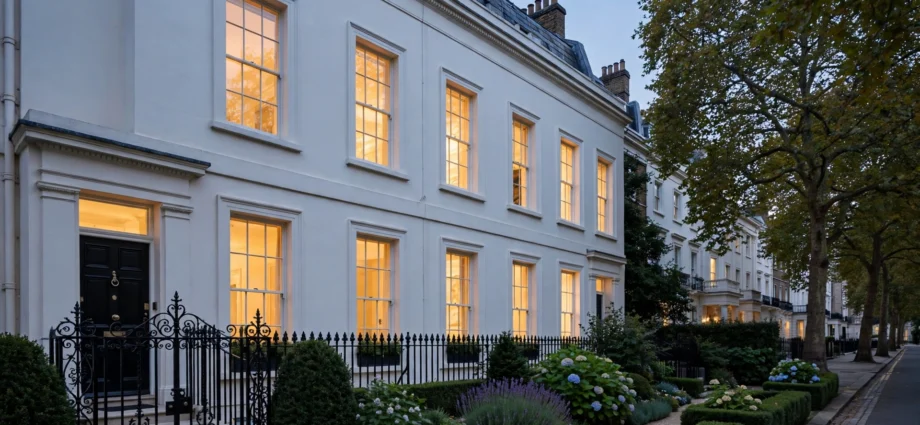
Buyers of prime London homes negotiate hard over the purchase price, then discover that the price was only the first bill. A luxury London home keeps charging every year: council tax, service charges, insurance, utilities, upkeep, and, for many owners, staff and management. None of these is large on its own compared with the purchase price, which is exactly why they are underestimated. Added together, the annual running cost of a prime London home commonly runs to tens of thousands of pounds a year, and on a large freehold house it can pass £100,000 before a mortgage payment is counted.
This guide totals the full annual bill for a luxury London home, line by line, at prime price points. It covers council tax in Band H and the second home premium that now doubles the bill in Westminster and Kensington and Chelsea, service charges on prime leasehold flats, high-value insurance, utilities and upkeep on large period properties, and the staffing and management costs that overseas and part-time owners usually need. It ends with two worked annual totals, one for a £3 million prime leasehold flat and one for a £6 million freehold house, so you can see how the lines add up. The figures are illustrations based on published rates and standard rules of thumb, clearly labelled as such, because the exact bill depends on the borough, the building and how the home is used. Purchase costs are a separate question, covered in our guide to the total cost of buying a luxury property in the UK, and are not repeated here.
In brief: Budget for council tax, service charges, insurance, utilities, a maintenance reserve and, where relevant, staff or a property manager. On a prime leasehold flat, service charges are usually the largest single line. On a freehold house, the maintenance reserve and staffing usually are. If the home is a second home, check whether your borough charges the 100% council tax premium, because it doubles the council tax line. Keep a reserve for major works, because a single roof, lift or facade project can cost more than a year of ordinary running costs.
The Annual Bill Nobody Budgets For
The purchase price of a luxury home is a single number, negotiated once, and it dominates every conversation about buying. Running costs are the opposite: a dozen smaller numbers, arriving monthly and quarterly, from different payees, on different dates, and they never stop. That is why they catch buyers out. A buyer who has modelled the purchase to the pound can still be surprised by the first year of ownership, not because any one cost is shocking, but because no one added them up.
Three features of prime London ownership make the annual bill larger than buyers expect. The first is scale. A 3,000 square foot flat or a 5,000 square foot house costs more to heat, light, clean, insure and maintain than a standard home, and the difference is not proportional to floor area alone. High ceilings, large windows, stone and hardwood finishes, home automation, lifts, pools and gardens all add cost lines that a standard home does not have. The second is the leasehold structure of much of prime London. A flat in a mansion block or a new-build prime scheme carries a service charge that pays for the concierge, the lift, the common parts, the building insurance and the reserve fund, and on a luxury scheme that charge is measured in thousands of pounds a year, not hundreds. The third is absence. Many prime London homes are second homes, or are owned by people who live abroad for part of the year, and an absent owner pays for management, inspections and security that a resident owner provides for free by being there.
The practical discipline is simple: build the annual budget before you buy, from the actual figures for the actual property, not from a rule of thumb applied to the purchase price. Ask the seller or the managing agent for the last two years of service charge accounts, the current council tax band and bill, the buildings insurance premium and sum insured, and the utility bills. Those four documents tell you most of what you need to know, and a seller who cannot produce them is telling you something too.
Council Tax and the Second Home Premium
Council tax is the most predictable line in the annual bill, and the one that has changed most for luxury owners in the last two years. In England, council tax is charged in bands set by the Valuation Office Agency on the property’s value at 1 April 1991. Almost every prime London home sits in Band H, the top band, which covers properties valued at more than £320,000 at that date. Band H pays double the Band D rate, and the bill is set by the borough, so the same Band H home can cost very different amounts in different parts of prime London.
Westminster is the cheapest prime borough for council tax. Its Band H charge for 2026/27 is £2,095.70. Kensington and Chelsea is considerably dearer: its Band H charge for 2025/26, for a property outside a garden square, was £3,138.92, and the borough’s 2026/27 budget raised council tax by 4.99%. Garden square properties in Kensington and Chelsea pay more again, because a separate garden rate is added. Camden, Islington and other prime boroughs sit between these two, and the differences are worth checking before you buy, because the gap between the cheapest and dearest prime boroughs is more than £1,000 a year on the same Band H home, every year, for as long as you own it.
The bigger change is the second home premium. From 1 April 2025, English councils gained the power to charge up to 100% extra council tax on a furnished dwelling that is no one’s sole or main residence, under the Levelling-up and Regeneration Act 2023. In practice, that doubles the bill. Westminster applied the 100% premium from 1 April 2025 and confirmed in February 2026 that it continues at the maximum level for 2026/27, so a Band H second home in Westminster pays £2,095.70 doubled, which is £4,191.40 for the year. Kensington and Chelsea applies the 100% second home premium from 1 April 2026, so a Band H second home there pays roughly double its Band H charge, around £6,500 on the 2026/27 figures. Across England, 211 of 296 billing authorities charged the premium in 2025/26, and more joined in April 2026, so a second home almost anywhere in prime London now carries the premium.
There are exceptions, and they matter. The regulations set out classes of dwelling that cannot be charged the premium, including homes actively marketed for sale or let, job-related dwellings, and homes undergoing major repairs, each with its own conditions and time limits. A home being marketed for let, for example, can be excepted for up to 12 months on evidence from the letting agent. But the exceptions are narrow, they need evidence, and they expire. Do not assume your home qualifies. Check the position with the borough, in writing, before you rely on it.
A separate premium applies to homes left empty and unfurnished. A property empty for more than a year is charged a 100% premium, rising to 200% after five years and 300% after ten years. An overseas owner who leaves a home empty between visits should therefore keep it furnished and occupied, or accept that the council tax line can double or triple. The distinction between a furnished second home and an unfurnished empty home is a legal one, and the council will apply it on the facts, not on the owner’s intention.
One further change is on the horizon. In the November 2025 Budget, the government announced a High-Value Council Tax Surcharge on English properties valued at more than £2 million, planned from April 2028. The details are still to be confirmed, and the surcharge is not yet in force, so it does not belong in this year’s budget. But a buyer planning to hold a prime London home for the long term should know it is coming, and should watch for the final rates, because it will add a new line to the annual bill of every home above the threshold.
Service Charges and Reserve Funds
For a leasehold flat, the service charge is usually the largest single annual cost, and it is the line buyers most often misunderstand. The service charge is not rent, and it is not profit for the freeholder. It is the flat’s share of the cost of running the building: the concierge and porters, the lift, cleaning and lighting of the common parts, the building insurance, the managing agent’s fee, and contributions to a reserve fund for major works. The charge is set by the building’s actual costs, apportioned between the flats, usually by floor area, and it is demanded annually or half-yearly.
The rate depends entirely on the building. A standard London block might charge £3 to £5 per square foot a year. A prime or luxury scheme with a 24-hour concierge, a pool, a spa, a gym, a cinema room and valet parking commonly charges £8 to £14 or more per square foot a year. Our guide to service charges on luxury London flats explains what is included and what to look for in the accounts, and the figures there are worth reading before you make an offer. The arithmetic is straightforward: a 2,000 square foot flat in a prime scheme at £10 per square foot pays £20,000 a year in service charges, and a 3,000 square foot flat at £12 per square foot pays £36,000. These are ordinary figures for prime London, not extremes, and they rise with inflation, with insurance premiums, and with the cost of staffing the building.
Three things about service charges deserve attention. The first is the reserve fund, sometimes called the sinking fund. A well-run building collects a contribution each year towards future major works: a new lift, a roof replacement, a facade repair, a redecoration of the common parts. A building with a healthy reserve fund can meet those costs from the fund. A building without one will levy a one-off major works charge on the leaseholders, which can run to tens of thousands of pounds per flat. Ask for the reserve fund balance and the planned major works programme before you buy, and treat a large planned works programme with a small reserve as a cost you will pay, not as someone else’s problem.
The second is the first-year trap on new-build schemes. Developers set the first year’s service charge on estimates made before the building is fully occupied, and the true cost often becomes clear only in the second year, when independent contracts for cleaning, maintenance and insurance take effect. Increases of 15% to 30% between year one and year two are common on prime schemes. Budget for the second-year figure, not the marketing figure.
The third is ground rent, which is a separate charge from the service charge and is paid to the freeholder under the lease. On older prime leases, ground rent can be a meaningful annual sum, and some leases contain doubling clauses that increase it at intervals. On a lease extended under the statutory route, ground rent falls to a peppercorn. If you are buying a flat with a short lease, the ground rent and the cost of extending the lease belong in your thinking alongside the service charge, and our guide to lease extension cost on a prime London flat works through the numbers at prime values.
Freehold houses do not pay service charges, but they are not free of the equivalent costs. A freehold owner pays directly for everything a service charge covers in a block: the building insurance, the maintenance of the structure, the garden, the drive and the boundary walls. The money is the same. Only the payee changes.
Insurance, Utilities and Upkeep
Insurance is the line that protects every other line. Buildings insurance on a luxury home is priced on the rebuild cost, not the market value, and the premium follows the sum insured, the construction, the listed status and the contents. A high-value policy on a prime London home, with buildings and contents together, commonly costs a few thousand pounds a year, and considerably more on a large listed house with specified art, jewellery and collections. The premium is small next to the service charge, but the consequence of getting the cover wrong is not, because underinsurance reduces every claim in proportion to the shortfall. Our guide to high-value home insurance and rebuild cost explains the average clause, the reinstatement cost assessment, and how to cover art and jewellery, and it is worth reading alongside this guide, because the insurance line and the upkeep line are two sides of the same risk.
Utilities on a large prime home are a serious annual cost, and they are the line most often underestimated by buyers moving from a standard home. A large period house with high ceilings, single glazing in places, and a heating system sized for a different era can cost £5,000 to £10,000 a year or more to heat and light, and a home with a pool, a spa or extensive outdoor lighting costs more again. A modern prime flat with efficient systems costs less, but a 2,000 square foot flat still commonly runs to £3,000 to £5,000 a year for heating, electricity and water combined. Energy prices move, so the figure should be taken from the actual bills for the property, not from a national average. Ask for them. A seller who heats a large house will have the bills, and they are more informative than any estimate.
Upkeep is the line that separates owners who preserve value from owners who watch it drain away. The standard rule of thumb is to allow 1% of the property’s value a year for maintenance on a freehold house, and 0.4% a year for the interior of a leasehold flat, with older properties needing more and new-builds in warranty needing less. On a £6 million freehold house, 1% is £60,000 a year. That is a reserve allowance, not a bill that arrives every year, and in a good year you will spend less. But over a decade, a large period home will need a roof, a boiler, joinery repairs, redecoration, and work to the garden and the boundary, and the reserve is what pays for them without a crisis. On a £3 million leasehold flat, 0.4% is £12,000 a year for the interior, on top of the service charge that covers the building itself. Treat the reserve as a real cost, set it aside, and do not confuse a year with no major repair for a year with no maintenance cost. The repair is coming. The only question is when.
Gardens and grounds deserve a line of their own on a freehold house. A large London garden with mature trees, hedges, a terrace and irrigation needs regular professional care, and a garden square contribution, where one applies, is an additional annual charge. Allow a few thousand pounds a year for a substantial garden, more if there are mature trees that need specialist work, and remember that a neglected garden is visible from the street and affects the value of the whole property.
Staffing and Management
A luxury home that is lived in full time by its owner needs little more than a cleaner and a gardener. A luxury home that is lived in part of the year, or owned from abroad, needs people, and people are the most expensive line in the annual bill after the service charge and the maintenance reserve.
A housekeeper for a prime London home commonly costs £35,000 to £50,000 a year in salary, before employer costs, and a full-time housekeeper or house manager for a large house costs more. A part-time cleaner is far cheaper, but a part-time cleaner does not notice the leak, the damp patch or the alarm fault. The choice is not between spending and saving. It is between paying for presence and paying for the damage that absence allows.
A property manager is the usual answer for an overseas owner. A full management service for a prime London home typically covers regular inspections, running the taps and the heating, checking the alarm and the security, arranging cleaners and trades, receiving post and deliveries, and reporting to the owner. The fee depends on the service and the property, and it is commonly charged as a monthly retainer plus the cost of works arranged. For a home that will stand empty for months, a manager who inspects weekly, runs the water, checks the heating and reports problems is not a luxury. It is part of the insurance arrangement, because many high-value policies impose conditions on unoccupied homes, including heating, inspections and draining the water system, and a failure to meet them can affect a claim.
Security is a related cost. A monitored alarm with a maintenance contract, CCTV, and, on some homes, a security patrol or a concierge arrangement, costs a few hundred to a few thousand pounds a year. It is a small line, and it is also a condition of many high-value policies, which commonly require defined security standards and an alarm maintained under contract. Read the requirements, meet them, and keep the maintenance contract current.
For a country estate, the staffing and management picture is larger again, and our Luxury Estate Guide covers the running costs of a country estate in that context. The principle is the same: the home costs what it costs to keep it occupied, secure and maintained, and the cost does not pause when the owner is elsewhere.
A Worked Annual Total
The lines above are easier to judge when they are added up. The two worked totals below are illustrations, built from the published rates and rules of thumb in this guide, and they exclude the mortgage, because financing is a separate decision, and they exclude purchase costs, which belong in the buying guide. Your own home will differ, and the point of the exercise is the shape of the bill, not the exact total.
A £3 million prime leasehold flat, 2,000 square feet, lived in for part of the year as a second home:
| Cost line | Annual figure |
|---|---|
| Council tax, Band H, Westminster, as a second home (100% premium) | £4,191 |
| Service charge, 2,000 sq ft at £10 per sq ft | £20,000 |
| Ground rent | £250 |
| Buildings and contents insurance | £3,500 |
| Utilities (heating, electricity, water) | £4,000 |
| Interior maintenance reserve (0.4% of value) | £12,000 |
| Property manager and inspections | £6,000 |
| Cleaning | £5,000 |
| Total | £54,941 |
A £6 million freehold house in prime London, lived in full time:
| Cost line | Annual figure |
|---|---|
| Council tax, Band H, Kensington and Chelsea, main residence | £3,296 |
| Buildings and contents insurance | £6,000 |
| Utilities (heating, electricity, water) | £8,000 |
| Maintenance reserve (1% of value) | £60,000 |
| Garden and grounds | £6,000 |
| Housekeeper (part time) and cleaning | £18,000 |
| Alarm, security and maintenance contracts | £2,000 |
| Total | £103,296 |
Two observations follow from these totals. The first is that the freehold house costs roughly twice the leasehold flat to run, even though the purchase price is only twice as large, because the maintenance reserve scales with value and the house carries staffing and garden costs the flat does not. The second is that the reserve lines, the maintenance reserve and the service charge reserve fund, are the largest items in both totals, and they are also the lines owners are most tempted to skip in a good year. Skipping them does not remove the cost. It moves it into the future, with interest, in the form of a major works bill or a repair that has become a rebuild.
Frequently Asked Questions
How much does it cost to run a luxury London home each year?
A prime leasehold flat commonly costs £40,000 to £60,000 a year to run, excluding the mortgage, and a large freehold house commonly costs £80,000 to £120,000 or more. The exact figure depends on the borough, the building, the size, and how the home is used, and the service charge and the maintenance reserve are usually the largest lines.
What is council tax on a luxury London home?
Almost every prime London home is in Band H, the top band, which covers properties valued at more than £320,000 at 1 April 1991. In 2026/27, Band H in Westminster is £2,095.70. In Kensington and Chelsea, Band H was £3,138.92 in 2025/26, before the borough’s 4.99% rise for 2026/27. If the home is a second home, the bill doubles in boroughs that charge the 100% premium, which includes Westminster and Kensington and Chelsea.
Does the second home premium apply to my London flat?
If the flat is furnished and is no one’s sole or main residence, and your borough has adopted the premium, yes. Westminster has charged the 100% premium since 1 April 2025, and Kensington and Chelsea from 1 April 2026. There are narrow exceptions, including homes actively marketed for sale or let, but they need evidence and they expire, so check the position with the borough in writing.
Are service charges included in the purchase price?
No. Service charges are an annual cost of ownership, paid on top of the purchase price, and they continue for as long as you own the flat. On a prime scheme, expect £8 to £14 or more per square foot a year, and budget for the second-year figure on a new-build, not the developer’s first-year estimate.
What is the 1% maintenance rule?
It is a rule of thumb that a freehold house needs about 1% of its value a year set aside for maintenance, and a leasehold flat needs about 0.4% a year for its interior, on top of the service charge. It is a reserve allowance, not a bill, and it should be set aside even in years when little needs doing, because major repairs arrive in lumps.
Should I budget differently if I live abroad?
Yes. An overseas owner should add a property manager, regular inspections, and the cost of meeting the unoccupancy conditions of the insurance policy, and should check the council tax position carefully, because a home that is a second home, or that stands empty, can attract the 100% premium or the empty homes premium. A manager who inspects weekly and reports problems is usually the cheapest insurance an absent owner can buy.
What is the High-Value Council Tax Surcharge?
It is a surcharge on English properties valued at more than £2 million, announced in the November 2025 Budget and planned from April 2028. It is not yet in force and the final rates are still to be confirmed, so it does not belong in this year’s budget, but long-term owners of prime London homes should watch for it.
Written and reviewed by the My Luxury Property editorial team. This article is general information on the annual running costs of a luxury London home in the UK and does not constitute legal, tax or financial advice. Council tax bands, premiums and rates are set by individual boroughs and change each year, so confirm the current figures with the relevant council and obtain written advice from your solicitor, tax adviser and broker on your own property.