
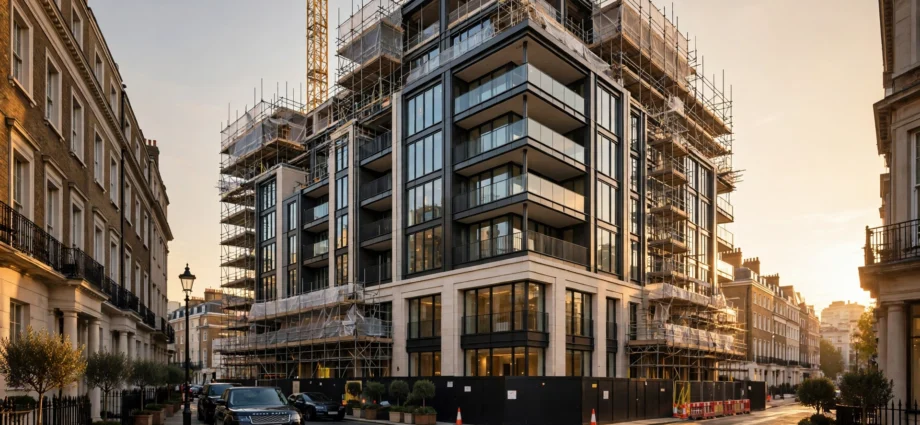
Buying off-plan means buying a home that does not exist yet. You choose it from floor plans, a brochure and a show apartment, you exchange contracts months or years before completion, and you pay the balance when the developer says the building is ready. For a prime London buyer, especially one buying from overseas, that gap between exchange and completion is where both the opportunity and the risk sit.
The opportunity is real. You can secure a flat in a sought-after scheme before it is released to the wider market, choose the floor, the aspect and sometimes the finishes, and, if the market rises during construction, complete on a property worth more than the price you agreed. The risks are equally real, and they are different from the risks of buying an existing home. You cannot inspect what you are buying, your mortgage offer will not last until completion, and the service charge you were quoted at launch may not be the service charge you pay in year one.
This guide works through off-plan buying in prime London from the overseas buyer’s point of view: how it works, where your deposit money sits, the five risks that matter most, what assignment means, and how completion works when you are abroad. It is general information, not legal or financial advice, and your solicitor’s advice on your own contract always governs your purchase.
In brief: Off-plan risk concentrates in five places: delay beyond the promised date, a valuation at completion below the price you agreed, specification changes between brochure and finished flat, developer failure before completion, and a service charge estimate that rises once the building is running. None of these is a reason to avoid off-plan buying outright. Each of them is a reason to read the contract, check the deposit protection, and budget for the completion-day shortfall before you exchange.
How Off-Plan Buying Works in Prime London
The process starts with a reservation. You pay a reservation fee, usually a modest sum held for a short period, typically two to four weeks, while your solicitor reviews the contract and you arrange your finances. Reservation does not make you the owner, and it does not bind the developer beyond the reservation period. It buys you time to do the checks that matter.
Exchange of contracts is the binding step. From exchange, you are contractually committed to buy at the agreed price, and the developer is committed to build and deliver the property described in the contract, subject to its terms. The exchange deposit, conventionally 10 percent of the price, is paid at this point. On a £3 million flat, that is £300,000 committed long before you hold a key.
Between exchange and completion, the developer builds. You will usually receive construction updates and may be invited to choose finishes at defined stages, but you have no right to direct the build, and your ability to visit the site is limited and controlled. Practical completion is the developer’s certification that the building is finished to the contract standard. It triggers the completion notice, and from that notice the contractual clock to completion starts, commonly ten working days, though your contract states the exact period.
Completion is when the balance is paid, the lease is granted, and the keys are released. Stamp duty is payable at completion, or earlier if there is substantial performance, and the tax position for an overseas buyer is explained in our guide to stamp duty for overseas buyers, including the 2 percent non-resident surcharge and the 5 percent additional-property surcharge where they apply. For the full purchase budget that sits around an off-plan price, read our guide to the total cost of buying a luxury property in the UK, which totals legal fees, surveys and the other costs that sit on top of the price itself.
The Deposit Structure and Where Your Money Sits
The deposit is the first question to ask, before the specification, the view or the payment plan. On prime London schemes the usual structure is a reservation fee followed by a 10 percent deposit on exchange, with the balance of 90 percent payable on completion. Some schemes ask for staged payments during construction, for example a further 10 percent at defined construction milestones, leaving 80 percent on completion. A staged structure reduces the developer’s funding risk and increases yours, because more of your money is committed before the flat exists, so read the stages, not just the headline deposit.
Where the deposit sits matters as much as its size. In England and Wales the exchange deposit is normally paid to the developer’s solicitor. Whether it is held as stakeholder or as agent is a contract term with a real consequence. Money held as stakeholder is held for both parties and is normally returned if the transaction does not proceed through no fault of the buyer. Money held as agent may be released to the developer before completion, which means that if the developer fails, recovering it depends on the developer’s remaining assets. Ask your solicitor to confirm, in writing, which basis applies, and do not assume that a prime brand name removes the question.
Currency adds a second deposit risk for overseas buyers. A staged deposit paid in sterling from a foreign currency account exposes each payment to the exchange rate on that day. A sterling price fixed at exchange, paid in stages over two years, can cost materially more in your home currency if sterling strengthens in the meantime. Some buyers fix the currency cost of future staged payments through their currency provider at the point of exchange. Whether that is right for you is a financial decision, but ignoring the exposure is not a strategy.
Risk One: Delay Beyond the Promised Date
Delay is the most common off-plan disappointment and, on its own, usually the least dangerous. Construction overruns happen for ordinary reasons: planning conditions, supply problems, labour shortages, and the sheer complexity of a prime scheme with bespoke finishes. The contract deals with delay through two dates that buyers often confuse.
The first is the estimated completion date, which is the developer’s target and is usually expressed as a quarter or a season, not a day. The second is the longstop date, which is the contractual backstop, often set well beyond the estimate. Until the longstop date passes, the buyer generally cannot walk away for delay alone, and the developer is not in breach for missing the estimate. The gap between the two dates can be a year or more, and during that gap your deposit is committed, your mortgage offer may expire, and your own plans, a relocation, a sale elsewhere, or a tax year, may move against you.
Protect yourself by reading the longstop date as the real date, not the brochure date. Ask what happens at the longstop date, whether you can rescind and recover your deposit if it passes, and whether the contract gives the developer a right to extend it further by notice. Budget for delay in your own timetable, and do not make an irreversible commitment, such as selling your existing home or giving notice on a tenancy, that depends on the estimated date alone.
Risk Two: Valuation at Completion
Valuation risk is the risk that bites hardest at prime level, because the sums are largest. You agree a price at exchange. Two or three years later, at completion, your lender values the flat. If the market has fallen, or if the valuer judges the scheme less favourably than the developer’s launch pricing, the valuation can come in below the price you agreed. This is sometimes called a down valuation.
A down valuation does not reduce the price you contracted to pay. It reduces the amount your lender will lend against that price. If you agreed £3 million with a 60 percent loan, and the flat values at £2.7 million at completion, the lender will lend against £2.7 million, and you must fund the £180,000 difference from your own resources, on top of the deposit you have already paid, or renegotiate, or risk default. Mortgage offers also expire, typically after six months, so an offer obtained at exchange will not survive to a completion two years later. You will need to reapply, at whatever rates and criteria apply then, with your finances rechecked.
The practical protection is liquidity. Before exchanging, ask yourself whether you could complete if the valuation fell by 10 percent and lending terms tightened, and whether you could complete with no mortgage at all if you had to. Buyers who can only complete at the launch price, with the launch mortgage, are the buyers most exposed to this risk. Cash buyers avoid it entirely, which is one reason developers value them, but a cash buyer still faces the other four risks.
Risk Three: Specification Changes Between Brochure and Finished Flat
The flat you buy off-plan is described in the contract, not in the brochure. Brochures and show apartments are marketing material. The contract will usually allow the developer to make changes, within defined limits, to layout, materials and finishes, for construction or supply reasons. The question is how wide those limits are.
Minor changes are normal: a tile or a worktop substituted for an equivalent, a socket moved, a dimension varied by a small tolerance. Material changes are the risk: a room smaller than the plan suggested, a view obstructed by a plant room or a neighbouring structure that was not shown, a finish level below what the show apartment promised. At prime level, where the buyer is paying for bespoke joinery, stone and brassware, the difference between the specified standard and the delivered standard is worth real money.
Read the specification schedule in the contract, not the brochure, and check three things: whether dimensions are approximate and within what tolerance, whether substitutions must be of equal or better quality and who judges that, and what remedy you have if the delivered flat differs materially, whether that is a price reduction, a right to rescind, or nothing at all. Keep the brochure, the plans and the specification together in one file, and photograph the show apartment finishes you were shown. At handover, snag everything against the specification before you accept the keys, because defects raised after completion are harder to get fixed than defects listed on a snagging schedule at handover.
The New-Build Premium: Do Luxury New Builds Lose Value?
Closely related to valuation risk is the new-build premium, the amount by which a new home sells for more than an equivalent existing home. A premium is normal: you are buying a new building, a warranty, modern services and a finish you chose. The question is its size, and whether it survives resale.
In prime London, the premium varies sharply by scheme. A well-located scheme with a strong developer, a long lease and sensible service charges tends to hold its value better than a scheme priced at the top of its area on launch hype, with a short lease or an unusually high service charge. Research the resale market in the same building, if earlier phases have completed, and in comparable completed schemes nearby. Ask your agent what similar flats resell for, not what they launched for. A launch price that already assumes several years of growth leaves no room for the market to do the work for you, and a valuation at completion is the moment that gap becomes visible. Treat any promise of guaranteed growth or guaranteed rental return as marketing, not as a contractual term, and never let it substitute for the valuation analysis above.
Risk Four: Developer Failure Before Completion
Developer failure is the rarest of the five risks and the most serious when it happens. If the developer becomes insolvent before completion, the buyer faces two separate questions: what happens to the deposit, and what happens to the building.
The deposit question turns, again, on whether it was held as stakeholder or released to the developer as agent, and on any deposit protection or insurance the scheme carries. The building question turns on whether another developer or funder steps in to finish the scheme, which happens more often than total abandonment on a prime London site, but is never guaranteed and always takes time. During that time your deposit is tied up and your purchase is in limbo.
Mitigation is due diligence before exchange, not optimism after it. Ask your solicitor to check the developer’s track record on completed schemes, whether the site is owned or optioned, how the build is funded, and what warranty will cover the finished home. A 10-year structural warranty from an established provider, such as NHBC or an equivalent, is standard on new homes and covers defined structural defects after completion, but it is not deposit insurance and it does not guarantee the developer finishes the build. Separate the two protections in your mind, and confirm both in writing.
Risk Five: Service Charge Estimates on Prime Schemes
The service charge is the risk buyers most often discover after completion, when it is too late to renegotiate. At launch, the developer or agent quotes an estimated service charge, often expressed per square foot per year. On a prime scheme with a concierge, a gym, a pool, a cinema room, gardens and a residents’ lounge, that estimate can be substantial, and it is only an estimate.
Once the building is running, the actual cost is set by the real costs of staffing, maintenance, insurance, energy and reserve fund contributions, and by the terms of the leases in the building. If the launch estimate was optimistic, or if the first year’s costs include snagging and set-up items, the charge can rise sharply in year two. The lease also matters: check whether the service charge is capped in any way, how major works are funded, whether there is a reserve or sinking fund and how it is built up, and whether commercial or hotel elements in a mixed-use scheme contribute fairly to shared costs. A prime flat with an uncapped, fast-rising service charge is harder to sell and harder to let, and the service charge affects value long after the purchase price is forgotten.
Ask for the estimated service charge budget in writing, with its assumptions, and compare it with completed schemes by the same developer and with similar buildings in the area. If the estimate looks low for the facilities promised, budget for the higher figure, not the brochure figure.
Assignment: Selling Before Completion
Assignment means selling your contractual right to buy the flat, before completion, to another buyer. Some off-plan buyers plan to assign, others need to assign because their circumstances change. Either way, the right to assign is not automatic. It depends entirely on the contract.
Many prime contracts restrict assignment, require the developer’s consent, charge an assignment fee, or prohibit assignment altogether until a defined stage, or allow it only once and only to a buyer the developer approves. Some contracts also require the original buyer to remain liable if the assignee defaults. Assignment can also have tax consequences, and the assignee will usually need their own mortgage and solicitor, which takes time. If you might need to assign, confirm before exchange whether assignment is permitted, on what terms, at what fee, and whether your deposit transfers or is refunded and repaid. Do not exchange on the assumption that you can sell the contract on if the market moves against you.
Completing from Overseas
Completing an off-plan purchase from abroad is routine in prime London, but it needs planning. You will usually complete through your solicitor under a power of attorney or by signing documents abroad with the required witnessing and certification, and your funds must arrive as cleared sterling funds in your solicitor’s client account by the completion date. The completion notice period, commonly ten working days, leaves little room for a currency transfer that goes wrong, a document that needs re-execution, or a bank compliance check that takes longer than expected.
Prepare early. Agree the signing method with your solicitor before the completion notice arrives, not after. Keep your source of funds evidence current, because a large balance payment will trigger fresh checks. Diarise the completion window, the stamp duty return deadline, which falls within 14 days of completion, and the handover and snagging inspection, which you or your representative should attend in person or by video. Once you own the flat, the next budget is furnishing it, and our guide to the luxury interior designer cost in London explains the fee models and the turnkey route that matters most to owners who live abroad.
A final practical point: do not confuse exchange with ownership. Until completion, you do not own the flat, you cannot let it, and you cannot change it. Insurance, tax and letting plans all start at completion, and any cost you incur before then, on furniture, on a letting agent, or on a move, is incurred at your own risk.
Frequently Asked Questions
What deposit do I pay when buying off-plan in London?
Conventionally 10 percent of the price on exchange of contracts, with the balance on completion. Some schemes ask for staged payments during construction. Always confirm whether the deposit is held as stakeholder or as agent, because that determines what happens to it if the developer fails.
Can I pull out of an off-plan purchase if it is delayed?
Usually only after the contractual longstop date passes, and only on the terms the contract sets out. Missing the estimated completion date alone does not normally give a right to rescind. Read the longstop date and the rescission terms before you exchange.
What happens if my flat values for less than the price at completion?
The price you contracted to pay does not change. Your lender will lend against the lower valuation, so you must fund the shortfall from your own resources, renegotiate, or risk default. Budget for a down valuation before you exchange, not after it happens.
Can I sell an off-plan flat before completion?
Only if the contract allows assignment, and usually only with the developer’s consent and on payment of an assignment fee. Some contracts prohibit assignment altogether. Confirm the assignment terms before exchange if this matters to you.
Is the service charge fixed when I buy off-plan?
No. The launch figure is an estimate. The actual charge is set by the real running costs of the building once it is occupied, and it can rise, sometimes sharply, in the first years. Ask for the budget and its assumptions in writing and compare it with comparable completed buildings.
Should I buy off-plan or buy an existing luxury home?
It depends on what you value most. Off-plan offers choice of unit and finishes and, in a rising market, a price fixed early. An existing home offers certainty: you inspect what you buy, you complete in weeks, and the service charge and condition are known. If certainty and a known valuation matter more than choice, an existing home is usually the safer route.
Written and reviewed by the My Luxury Property editorial team. This article is general information on buying off-plan property in London and does not constitute legal, tax or financial advice. Contract terms, deposit arrangements and service charges vary by scheme, and you should obtain written advice from your solicitor and surveyor on your own purchase.