
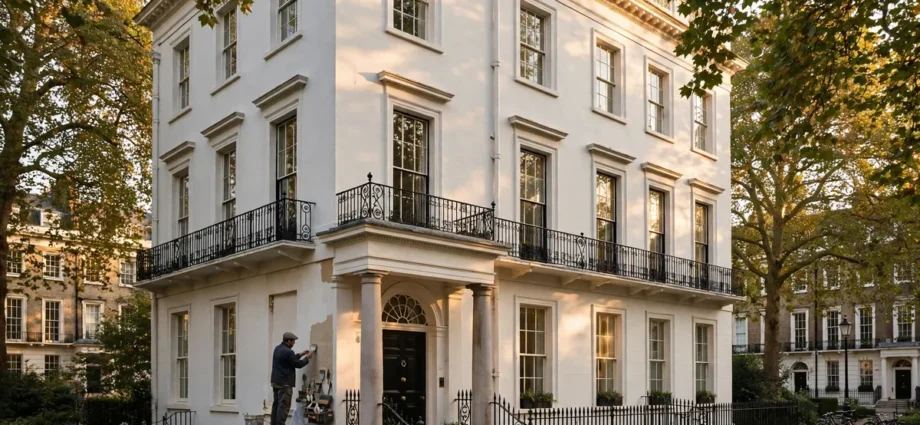
A buyer falls in love with a house. It is a Georgian townhouse on a garden square in Belgravia, or a Regency terrace in Bath, or a Victorian villa in Hampstead with the original staircase, the plaster cornices and the marble fireplaces still intact. The price is £4 million. The location is perfect. The only problem is the kitchen, which was last fitted in the 1980s, the bathrooms, which need a complete rethink, and the layout, which does not work for modern family life. The buyer plans to renovate. Then the solicitor mentions the word that changes everything: listed.
A listed building is not simply an old building. It is a building on the National Heritage List for England, protected by law because of its special architectural or historic interest. That protection covers the whole building, inside and out, not just the facade. It means that almost any change affecting the character of the building needs a separate permission called listed building consent, that the work must use specialist materials and trades, and that the renovation will cost substantially more and take substantially longer than the same work on an unlisted house. For a luxury buyer, the stakes are higher than for anyone else, because the specification is higher, the finishes are more expensive, and the cost of getting it wrong is measured in six figures and, in the worst cases, in a criminal record.
This guide sets out the rules for renovating a listed luxury home in the UK, the realistic costs at prime London specification, and the practical decisions that separate a successful heritage renovation from an expensive mistake. It is general guidance, not legal or professional advice, and the listing itself, the local conservation officer and the buyer’s heritage advisers are always the final word.
In brief: A listed building needs listed building consent for any work that affects its character, inside or out, and consent is separate from planning permission. There is no application fee for listed building consent in England, but the surveys, drawings and heritage statement behind it typically cost £800 to £2,500 in agent fees, and a decision usually takes 8 to 13 weeks. Carrying out unauthorised work is a criminal offence under the Planning (Listed Buildings and Conservation Areas) Act 1990, punishable by up to two years in prison or an unlimited fine. A full refurbishment of a listed property costs roughly £1,800 to £3,200 per square metre nationally, and £2,800 to £4,500 or more per square metre in London before VAT and fees, which is roughly 20 to 40 per cent more than an equivalent unlisted period property. Approved alterations to listed homes carry 20 per cent VAT. Insurance during works and afterwards costs more, typically 20 to 50 per cent above a standard policy, and the reinstatement value must reflect heritage materials and techniques, not modern rebuilding costs.
Consent Comes First: Listed Building Consent and Planning Permission
The first rule of renovating a listed home is that consent comes before work, not after it. Listed building consent is a separate permission from planning permission, and the two are applied for separately. For most internal alterations, only listed building consent is needed. For extensions, external changes or a change of use, both are usually needed. Neither is covered by permitted development rights, so there is no automatic allowance for small extensions, porches or outbuildings on a listed home.
What needs consent is wider than most buyers expect. The listing protects the whole building, inside and out, regardless of which features are mentioned in the listing description. Removing a partition, taking out a fireplace, replacing a staircase, altering a run of cornice, changing windows or doors, re-roofing, adding a flue or a rooflight, and installing a modern kitchen or bathroom in a way that damages original fabric can all require consent. The test is whether the work affects the character of the building. If a conservation officer would notice the change and consider it to affect character, assume consent is required and ask before starting.
The application itself is free in England. There is no fee for listed building consent. The real cost sits behind the application: a measured survey, drawings, a heritage statement explaining how the proposed work affects the building’s significance and how any harm will be mitigated, and often a structural engineer’s input. Agent fees for preparing an application typically run from £800 to £2,500 for a domestic project, and on listed projects professional fees generally sit at the top of the usual 10 to 15 per cent of build cost. A domestic listed building consent application typically takes 8 to 13 weeks from validation to decision, and the statutory target is eight weeks, but in practice a buyer should allow longer, particularly in London boroughs where conservation officers carry heavy caseloads.
The consequence of skipping consent is the part buyers most often underestimate. Carrying out unauthorised work to a listed building is a criminal offence under section 9 of the Planning (Listed Buildings and Conservation Areas) Act 1990, not merely a planning breach. The maximum penalty is two years in prison, an unlimited fine, or both. Enforcement can also require the work to be reversed, which on a luxury renovation means stripping out a finished kitchen or bathroom at the owner’s expense. There is no time limit that makes unauthorised work safe: the ten-year rule that applies to some planning breaches does not apply to listed building consent, and unauthorised works remain liable to enforcement regardless of how long ago they were done. A buyer who inherits unauthorised work from a previous owner inherits the liability too, which is why the pre-purchase checks matter as much as the renovation itself.
The practical sequence is straightforward. Before exchanging on a listed home with renovation plans, take pre-application advice from the council’s conservation officer. It is not free in every borough, but it is the cheapest money in the whole project, because it establishes what the council will and will not accept before the buyer is committed. Then commission the heritage statement and drawings, submit the application, and do not instruct the contractor until consent is granted. A contractor who offers to start while consent is pending is a contractor to avoid.
The Three Grades and What Each One Means for Your Plans
Not all listings are equal. Historic England maintains the National Heritage List for England, and buildings are classified into three grades. Grade I covers buildings of exceptional interest, including cathedrals, major stately homes and nationally significant architecture, and accounts for about 2.5 per cent of listed buildings. Grade II* covers particularly important buildings of more than special interest, about 5.5 per cent. Grade II covers buildings of special interest, and it is by far the most common grade, covering about 92 per cent of listed buildings. Most luxury buyers renovating a listed home will be dealing with a Grade II property.
The grade matters because it sets the tone of the consent process. A Grade II listing is the most flexible in principle, but flexible does not mean permissive. Consent is still required for most alterations, and the conservation officer will still expect like-for-like repair and sympathetic materials. A Grade II* or Grade I listing is substantially more restrictive, and significant internal alterations are rarely permitted. On a Grade I home, the expectation is preservation, and a buyer should assume that the layout, the principal rooms and the historic fabric are effectively fixed.
The grade also affects cost. The higher the grade, the more specialist the trades, the more detailed the heritage statement, and the more likely the council is to require a conservation-accredited architect rather than a general practice. A buyer considering a Grade I or Grade II* home should budget professional fees at the top of the range and should expect the consent process to take longer and to involve more negotiation.
For the buyer, the grade is the first fact to establish, and it is easy to check. The National Heritage List for England is searchable online, and the listing entry itself describes the building and, often, the features the listing protects. The guide to Grade II listed building restrictions sets out what the most common grade means in practice for a luxury buyer, and it is the legal parent to this guide: the restrictions live there, and the costs and process live here.
What You Can and Cannot Change
The question every buyer asks is what they are actually allowed to change, and the honest answer is that it depends on the building, the grade and the conservation officer. But some patterns hold across almost every listed luxury home.
What is usually possible, with consent, is the renewal of services and finishes that do not affect historic fabric. Rewiring, replumbing, new heating systems, secondary glazing behind original sash windows, like-for-like repair of sash windows, and the sympathetic renewal of kitchens and bathrooms in rooms that have already been altered are the changes most commonly approved. Repair comes first in the conservation officer’s mind: like-for-like repair, sash overhauls and secondary glazing are the easiest changes to get approved, because they preserve the building rather than changing it.
What is difficult or impossible is anything that removes or damages original fabric. Removing a period fireplace, taking out a run of cornice, replacing original sash windows with uPVC, opening up a principal room by removing a structural wall, or altering the external appearance of the building will usually be refused, or approved only with conditions that make the work far more expensive than a standard equivalent. A modern kitchen can be installed, but it must be installed in a way that does not damage the original fabric, which usually means freestanding or carefully sited joinery rather than chasing services into historic plasterwork.
Bathrooms are a particular test. A luxury bathroom in a listed home is one of the most expensive rooms in the house to deliver, because the stone, the brassware and the wet room detailing must all be installed without damaging the structure, and because drainage and waterproofing in a building with timber floors and lime plaster need specialist design. The guide to luxury bathroom renovation cost UK sets out the cost bands for a prime bathroom, and on a listed home the buyer should expect to sit at the top of those bands. Kitchens follow the same logic. The guide to luxury kitchen renovation cost UK gives the prime specification bands, and a listed kitchen adds the cost of specialist joinery, conservation-approved materials and the slower pace of work around historic fabric.
The rule that saves buyers the most money is the simplest: design around the building, not against it. A renovation that works with the existing layout, keeps the principal rooms intact and concentrates change in rooms that have already been altered will pass through consent faster, cost less and preserve the value that the listing itself creates. A renovation that fights the building, by opening up principal rooms or removing period features, will cost more, take longer and may be refused altogether.
Specialist Materials and Trades: Where the Extra Cost Comes From
The cost premium on a listed renovation does not come from a single item. It comes from everything being slightly harder, slightly slower and slightly more specialist than the same work on an unlisted house.
Materials are the first difference. A listed home must be maintained and repaired sympathetically, which means lime mortar rather than cement, handmade bricks rather than machine-made, timber sash windows rather than uPVC, and traditional plaster rather than modern gypsum. These materials cost more, and they are harder to source. Lime mortar, for example, cannot be bought off the shelf in the same way as cement, and it must be applied by someone who understands how it cures. Repointing with cement mortar rather than lime mortar is not merely a specification error: on a listed building it can damage the brickwork and it can be an unauthorised alteration in its own right.
Trades are the second difference. A listed renovation needs craftspeople who understand historic buildings: joiners who can repair a sash window rather than replace it, plasterers who can run a cornice in lime, stonemasons, roofers experienced in slate and lead, and electricians and plumbers who can route services without chasing into historic fabric. Those trades charge more than general trades, and they are in shorter supply, which means longer lead times and less flexibility on programme. A contractor who has never worked on a listed building will price the job as if it were a standard refurbishment, and the difference will emerge later, in variations and delays.
The third difference is the pace of work. A listed renovation is slower because every intervention must be considered, because consent conditions may require work to be done in a particular sequence, and because discoveries are routine. Opening up a listed building almost always reveals something unexpected: a hidden beam, a previous alteration, damp behind plaster, or a structural issue that was not visible on survey. That is why the contingency on a listed project should be 20 to 25 per cent of the build cost, not the 10 per cent often quoted for standard projects. A buyer who budgets a 10 per cent contingency on a listed renovation is budgeting for a shortfall.
Realistic Costs: What a Listed Luxury Renovation Costs in 2026
Cost figures for listed renovation vary enormously by region, condition and specification, and any figure quoted without those caveats should be treated with suspicion. But the ranges below, drawn from current trade and builder sources, give a realistic starting point for a prime London project.
A full refurbishment of a listed property nationally costs roughly £1,800 to £3,200 per square metre, compared with perhaps £1,200 to £2,000 per square metre for a standard period renovation. In London, where labour rates, access costs and specification levels are all higher, a full heritage renovation typically runs from £2,800 to £4,500 or more per square metre before VAT and fees. On a 200 square metre townhouse, that puts a full London heritage refurbishment in the region of £560,000 to £900,000 before VAT and professional fees, and a buyer should treat the top of that range as the realistic figure for a prime specification rather than the bottom.
Professional fees sit on top of the build cost. On listed projects, fees tend to sit at the top of the usual 10 to 15 per cent of build cost, reflecting the heritage statement, the conservation-accredited architect, the structural engineer and the quantity surveyor. The consent application itself has no fee in England, but the agent fees for preparing it typically run from £800 to £2,500 for a domestic project, and pre-application advice from the council may carry its own charge depending on the borough.
Kitchens and bathrooms deserve their own lines in the budget, because they are where prime specification and listed constraints meet most expensively. A luxury kitchen in a listed home sits at the top of the prime cost bands, because the joinery must be bespoke, the appliances must be integrated without damaging fabric, and the services must be routed sympathetically. A luxury bathroom is similarly affected, because stone, brassware and wet room detailing in a building with timber floors and lime plaster need specialist design and installation. The kitchen and bathroom guides linked in this article give the prime bands, and a listed buyer should budget at the top of each.
The figure that matters most is the contingency. Budget 20 to 25 per cent of the build cost, not 10 per cent. On a £700,000 build cost, that is £140,000 to £175,000 held in reserve for the discoveries that a listed building will produce. A buyer who spends the contingency on specification upgrades before the work starts has no reserve left when the building reveals its secrets.
The Listed Premium: How Much More Than an Unlisted Home
The simplest way to think about the cost of a listed renovation is as a premium over the equivalent unlisted period property. Current trade sources put that premium at roughly 20 to 40 per cent, and the figure is consistent across the sources checked for this guide. A full refurbishment that would cost £1,200 to £2,000 per square metre on a standard period property costs £1,800 to £3,200 per square metre once the building is listed, and in London the gap is wider still.
The table below summarises the comparison at prime London specification. The figures are indicative ranges from the trade sources cited at the end of this guide, not quotations, and a specific building will vary with its condition, its grade and its location.
| Element | Listed luxury home | Unlisted period home |
|---|---|---|
| Full refurbishment per square metre | £2,800 to £4,500+ (London) | £1,200 to £2,000 |
| Cost premium over unlisted | 20 to 40% | Baseline |
| Contingency | 20 to 25% of build cost | 10% of build cost |
| Professional fees | Top of 10 to 15% of build cost | 10 to 15% of build cost |
| Consent application fee | £0 in England | Usually none needed |
| Agent fees for consent | £800 to £2,500 | Often none |
| VAT on approved alterations | 20% standard rate | 20% standard rate |
| Insurance | Typically 20 to 50% more | Standard |
The premium is not a penalty for owning a listed home. It is the cost of the materials, the trades and the time that a historic building requires, and it is also the cost of the protection that makes the building valuable in the first place. A listed townhouse on a prime London square commands its price partly because it cannot be altered casually, and the renovation premium is the price of keeping it that way.
Phased Works: Renovating While You Live in the Home
Many luxury buyers renovate while living in the home, and on a listed property that choice needs more planning than on an unlisted one. Phased works are possible, but they must be phased around the consent, not around the buyer’s convenience.
The first principle is that consent covers a defined scope of work. If the consent is granted for the whole renovation, the work can be phased within that consent, but if the buyer later decides to add a further phase, that phase needs its own consent. A buyer who intends to phase the work should apply for consent for the full scope from the start, even if the work will be delivered in stages, because a second application adds months and fees.
The second principle is sequencing. On a listed home, the structural and fabric work comes first: roof, damp, structural repairs, windows and external envelope. Services follow: rewiring, plumbing and heating. Finishes come last: kitchens, bathrooms, decoration and joinery. A buyer who starts with the kitchen and discovers a structural problem halfway through will pay twice, once for the kitchen and once for the work that should have come first.
The third principle is dust and protection. A listed interior cannot be protected with the same rough methods used on a standard site. Original plasterwork, cornicing, fireplaces and joinery must be protected throughout the works, and the cost of that protection, and of the cleaning that follows, should be in the budget from the start. A contractor experienced in heritage work will price protection properly. A contractor who has not will treat it as an afterthought, and the damage will be discovered when the protection comes off.
For an overseas buyer, phased works on an occupied home raise a further question: who is on site, and who is making decisions. A listed renovation needs decisions taken quickly, often in response to a discovery, and a buyer who is abroad needs a trusted agent on site with authority to act. That is usually the conservation-accredited architect or the project manager, and the arrangement should be agreed in writing before work starts, with clear limits on what the agent can approve without referring back to the owner.
Insurance During the Works and After
Insurance is the part of a listed renovation that buyers most often leave too late, and it is the part where the cost difference is most visible. Insuring a listed building costs more than a standard property, typically 20 to 50 per cent more for buildings insurance, and potentially significantly more for Grade I or Grade II* properties. The reason is the reinstatement cost. For a standard property, reinstatement means rebuilding to modern standards using modern materials. For a listed building, reinstatement means rebuilding using historically appropriate materials and techniques: lime mortar rather than cement, handmade bricks rather than machine-made, timber sash windows rather than uPVC. A listed building that would cost £300,000 to rebuild in modern materials might cost £500,000 to £800,000 to reinstate to heritage standards, and the policy must reflect that figure.
During the works, the position is more complex. A standard buildings policy may exclude work in progress, may limit cover while the property is unoccupied, or may require notification before work starts. A buyer should tell the insurer before work begins, not after, and should expect to need a specialist renovation or contract works policy for the duration of the project. That policy should cover the building, the materials on site, the works themselves and the public liability that comes with a building site in a prime residential area.
After the works, the reinstatement value must be reassessed. A renovation that adds a luxury kitchen, bathrooms and specialist finishes increases the reinstatement cost, and a policy that was adequate before the renovation may be inadequate afterwards. Underinsurance is the risk here, and it is a serious one: the average clause in a buildings policy means that if the property is insured for less than its true reinstatement cost, a claim is reduced in proportion. The guide to high-value home insurance and rebuild cost explains the average clause and the reinstatement cost assessment in detail, and a listed owner should read it before renewing a policy after a renovation.
VAT on Listed Building Work
VAT on listed building work surprises many buyers, because the rules changed and the old zero rating is gone. Since 1 October 2012, approved alterations to listed homes have been charged at the standard 20 per cent rate. Repairs have always been standard-rated. HMRC VAT Notice 708 sets out the rules, and the practical effect is that a buyer should budget VAT at 20 per cent on the full cost of the works, including the specialist materials and trades that make a listed renovation expensive in the first place.
There are narrow exceptions, and they are worth knowing about, but they should not be relied on without professional advice. The reduced rate of 5 per cent can apply in limited circumstances, including the conversion of a building into a different number of dwellings and certain energy-saving installations, but a straightforward renovation of a listed home for the owner’s own use does not qualify. A buyer whose adviser suggests a reduced rate should ask for the specific provision in writing, because the cost of getting VAT wrong is a bill from HMRC after the work is done.
The VAT position also affects the way costs are quoted. Builder and trade sources quote per square metre figures before VAT, and the £2,800 to £4,500 per square metre London range in this guide is before VAT and fees. A buyer who compares a quoted figure with a budget that includes VAT is comparing two different numbers, and the 20 per cent difference on a £700,000 project is £140,000. Every figure in a listed renovation budget should be labelled clearly as including or excluding VAT, and the total should always be the VAT-inclusive figure.
Buying a Listed Luxury Home with Renovation in Mind
The cheapest time to deal with a listed renovation is before the purchase, not after it. A buyer who plans to renovate should treat the pre-purchase checks as part of the purchase price, not as an optional extra.
The first check is the listing itself. Read the listing entry on the National Heritage List for England, establish the grade, and note the features the listing describes. The second check is the history of the building: has unauthorised work been carried out, and if so, by whom and when. Unauthorised work is a liability that passes to the new owner, and a conveyancer should ask specifically about it. The third check is the conservation officer. Pre-application advice before exchange establishes what the council will accept, and a buyer who discovers that their planned open-plan kitchen will be refused should discover it before they own the house.
The fourth check is the survey. A standard Level 3 building survey on a listed home should be carried out by a surveyor experienced in historic buildings, because the defects that matter on a listed property are not the defects that matter on a modern one. Damp in lime plaster, the condition of sash windows, the state of the roof structure and the presence of previous alterations all need a specialist eye. The fifth check is the budget. A buyer who has worked through the cost ranges in this guide, added the 20 to 25 per cent contingency and the 20 per cent VAT, and still finds the numbers workable is a buyer who can proceed with confidence. A buyer who has not done that work is buying a project, not a home.
A listed luxury home is, for the right buyer, one of the best purchases in prime London. It cannot be replicated, it cannot be built again, and its protection is part of its value. The renovation that respects the building, that works with its layout and its materials, and that is budgeted honestly, will produce a home that is both more comfortable and more valuable than the house that was bought. The renovation that fights the building, that skips consent, or that is budgeted on unlisted prices, will produce the opposite. The difference is not taste. It is preparation.
Frequently Asked Questions
Do I need listed building consent to renovate a listed home?
Yes, for any work that affects the character of the building, inside or out. That includes demolition, alteration and extension at every grade. If you are unsure whether a change counts, ask the council’s conservation officer before work starts. Listed building consent is applied for separately from planning permission, and for most internal alterations only the former is needed.
How much does it cost to renovate a listed luxury home?
A full refurbishment of a listed property costs roughly £1,800 to £3,200 per square metre nationally, and £2,800 to £4,500 or more per square metre in London before VAT and fees. That is roughly 20 to 40 per cent more than an equivalent unlisted period property. On a 200 square metre London townhouse, a full heritage refurbishment is in the region of £560,000 to £900,000 before VAT and professional fees.
Is there a fee for listed building consent?
No. Listed building consent itself is free to apply for in England. The costs are the surveys, drawings and heritage statement behind the application, with agent fees typically £800 to £2,500 for a domestic project, and professional fees on listed projects generally at the top of the usual 10 to 15 per cent of build cost.
How long does listed building consent take?
A domestic application typically takes 8 to 13 weeks from validation to decision. The statutory target is eight weeks, but in practice allow longer, particularly in London boroughs. Pre-application advice from the conservation officer can shorten the process by establishing what will be accepted before the formal application is submitted.
What happens if I carry out work without consent?
It is a criminal offence under section 9 of the Planning (Listed Buildings and Conservation Areas) Act 1990, punishable by up to two years in prison, an unlimited fine, or both. Enforcement can also require the work to be reversed at the owner’s expense. Unauthorised works remain liable to enforcement regardless of how long ago they were done, and the liability passes to a new owner.
Can I replace the windows in a listed home?
Replacing original sash windows with uPVC will almost always be refused. Like-for-like repair of the original windows, including sash overhauls, is the easiest change to get approved, and secondary glazing behind the original windows is usually acceptable. The conservation officer’s preference is always repair over replacement.
Can I install a modern kitchen or bathroom in a listed home?
Yes, with consent, provided the installation does not damage original fabric. Kitchens and bathrooms in listed homes are among the most expensive rooms to deliver, because services must be routed sympathetically and finishes must be installed without chasing into historic plasterwork. Budget at the top of the prime cost bands for both rooms.
Do I pay VAT on listed building work?
Yes, at the standard 20 per cent rate. Since 1 October 2012, approved alterations to listed homes have been charged at 20 per cent VAT, and repairs have always been standard-rated. HMRC VAT Notice 708 sets out the rules. Builder figures are usually quoted before VAT, so always confirm whether a figure includes VAT before comparing it with your budget.
Does insurance cost more for a listed home?
Yes, typically 20 to 50 per cent more for buildings insurance, and more for Grade I or Grade II* properties. The reinstatement cost must reflect heritage materials and techniques, not modern rebuilding costs, and the policy must be reassessed after a renovation. Tell the insurer before work starts, and expect to need a specialist renovation policy for the duration of the project.
Should I buy a listed home if I plan a major renovation?
It can be an excellent purchase, provided the renovation is planned before exchange. Take pre-application advice from the conservation officer, commission a survey from a surveyor experienced in historic buildings, check for unauthorised work by previous owners, and budget the full cost including the 20 to 25 per cent contingency and 20 per cent VAT. A renovation that works with the building will add value. One that fights it will cost more than it returns.
This guide is general information about renovating a listed luxury home in the UK as of November 2026. It is not legal, financial, tax or professional advice. Listed building consent rules, VAT treatment and insurance terms change, and the listing itself and the local conservation officer are the final authority on what a specific building requires. Figures are ranges from the trade and builder sources cited below, not quotations for any specific property. Check the listing, ask the conservation officer and take professional advice before buying or starting work.
Sources: building-projectmanager.co.uk, “Renovating a Listed Building: Costs, Consent and Rules” (per square metre ranges, contingency, agent fees, 8 to 13 week decision time); Buildaway, “Listed Property Renovation in London: Essential 2026 Guide” (London per square metre range, consent free in England, criminal offence penalties, £548 householder planning application from 1 April 2026, 20% VAT under HMRC VAT Notice 708, professional fees at the top of 10 to 15%); vidi-construction.co.uk, “Renovating a Listed Building: Key Considerations” (20 to 40% cost premium, grade proportions: Grade II about 92%, Grade II* 5.5%, Grade I 2.5%); homethink.co.uk, “Buying a Listed Building in the UK: What You Need to Know” (insurance typically 20 to 50% more, heritage reinstatement cost example). Grade proportions and cost ranges are as stated by those sources. Search volume and keyword difficulty are not verified.