
Ask ten people what a luxury kitchen renovation costs in the UK and you will get ten different answers, and most of them will be right. One guide puts a luxury kitchen at £20,000. Another puts it at £130,000 or more. A third quotes £140,000 for a single project. None of them is wrong. They are describing different kitchens, and the word luxury is doing a different job in each one.
That is the problem with pricing a luxury kitchen, and it is the problem this guide solves. It starts by defining what luxury means at three distinct levels, because the price depends entirely on which level you are buying. It then works through what each level costs in 2026, where the money actually goes, what happens to the budget the moment walls start moving, and what a London postcode adds to every line. Every figure is drawn from published 2026 UK cost guides, and every figure is attributed to its source, because the sources disagree with each other and the disagreement is itself the most useful fact in this guide.
In brief: A premium kitchen in the UK costs roughly £30,000 to £55,000. A bespoke luxury kitchen costs £50,000 to £130,000 or more. A full structural remodel, where walls move and the room changes shape, costs £70,000 to £120,000 or more, and can pass £140,000. Cabinetry is the largest single cost at luxury level, appliances take 20 to 30 per cent of the total, and London and the South East add 15 to 30 per cent to national averages. A kitchen renovation typically adds 5 to 10 per cent to a property’s value, but that is a range from published research, not a promise about any single home.
What “Luxury” Means in a Kitchen
Before any number can mean anything, the three tiers need names and definitions. The guides disagree because they use the word luxury for all three.
Tier 1: Premium. A high-specification kitchen from a recognised premium brand or a good independent kitchen company, with quality cabinetry, stone worktops and branded appliances. The layout stays roughly where it is. The room is transformed, but the walls are not. Checkatrade puts this tier at £30,000 to £55,000, and ukcalculator puts its luxury band at £20,000 to £50,000 or more. This is the entry point to luxury, and it is where most prime London flats land.
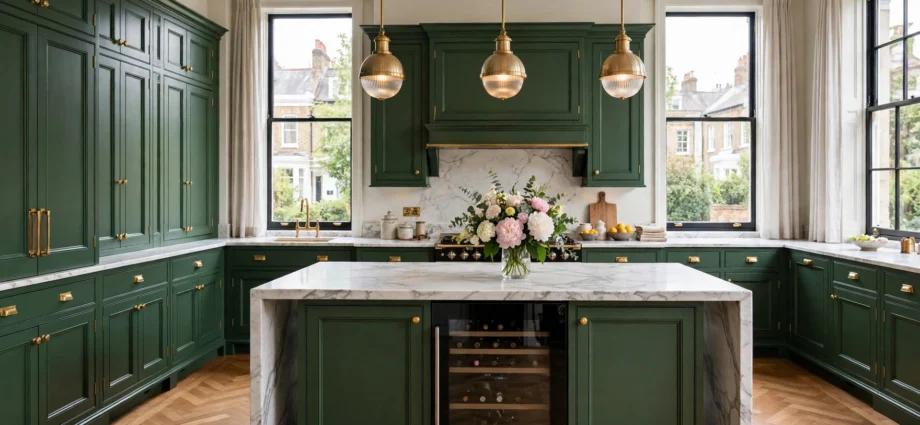
Tier 2: Bespoke luxury. Cabinetry made to measure for the room, usually by a specialist joiner or a bespoke kitchen studio, with hand-finished fronts, stone or quartz worktops cut to the design, and a premium appliance package. The kitchen is designed around the room and the way the household cooks and entertains, not fitted into a standard range. Samwaitekitchens, a bespoke kitchen company, puts this tier at £50,000 to £130,000 or more, and kitchencostestimator puts its luxury band at £35,000 to £60,000 or more. The wide range reflects how much bespoke means: a hand-painted in-frame kitchen with a stone island sits at the bottom of this tier, and a fully bespoke walnut and brass kitchen with a wine wall and a butler’s pantry sits at the top.
Tier 3: Full structural remodel. Everything in Tier 2, plus the room itself changes. Walls come out, a side return is extended, a basement is opened up, steels go in, and the kitchen becomes part of a larger open-plan living space. Aikitektly puts its premium and luxury remodel band at £70,000 to £120,000 or more, and samwaitekitchens cites a real example project at £140,000, in which five walls were removed and eight steels installed. At this tier the kitchen is a building project that happens to contain a kitchen, and the building work can cost as much as the kitchen itself.
The tiers matter because a buyer who asks for a luxury kitchen without naming the tier will be quoted a number that belongs to a different tier. The quote is not dishonest. The brief was incomplete. Name the tier first, and the numbers start to make sense.
Luxury Kitchen Renovation Cost by Tier
The table below brings the published 2026 ranges together. The budget and mid-range bands are included only as contrast, so the jump to luxury is visible. All figures include VAT at 20 per cent unless a source states otherwise.
| Specification level | Typical total cost (UK, 2026) | What it usually includes |
|---|---|---|
| Budget | £8,000 to £15,000 | Flat-pack or entry-level units, laminate worktops, standard appliances, no structural work |
| Mid-range | £15,000 to £35,000 | Better units, quartz or granite worktops, branded appliances, minor layout changes |
| Premium (Tier 1) | £30,000 to £55,000 | Premium brand or independent kitchen, stone worktops, branded appliances, layout largely unchanged |
| Bespoke luxury (Tier 2) | £50,000 to £130,000+ | Made-to-measure cabinetry, hand-finished fronts, stone worktops, premium appliance package |
| Full structural remodel (Tier 3) | £70,000 to £120,000+ | Everything in Tier 2 plus walls removed, steels, extension or reconfiguration of the room |
Two things stand out. First, the tiers overlap. A top-end premium kitchen at £55,000 costs more than an entry-level bespoke kitchen at £50,000, and a modest structural remodel at £70,000 costs less than a lavish bespoke kitchen at £130,000. The tiers describe what is being built, not a strict price ladder, and a quote should always be read against the specification behind it.
Second, the open-ended top of each range is doing real work. The plus sign on £130,000 or more is not a rounding error. At bespoke level there is no natural ceiling, because cabinetry, stone and appliances can all be specified upward without limit. A kitchen with a £20,000 fridge-freezer and a £15,000 range cooker is a different purchase from a kitchen with a £3,000 fridge-freezer and a £2,000 oven, and both are legitimately described as luxury.
Where the Money Actually Goes
A kitchen budget breaks down into five parts, and the proportions change sharply as the tier rises. At budget level, cabinetry and appliances dominate because there is little else. At luxury level, cabinetry dominates, appliances take a larger share than most buyers expect, and labour and structural work become major lines of their own.
Cabinetry. This is the largest single cost at luxury level. Published guides put luxury cabinetry at £20,000 to £50,000 or more, against £2,000 to £5,000 for budget units. The difference is not only the material. Bespoke cabinetry is measured, built and fitted for one room, with hand-finished fronts, dovetailed drawers, soft-close mechanisms throughout, and internal fittings such as pull-out larders, spice drawers and integrated bins specified to the household. A hand-painted in-frame kitchen from a specialist maker costs materially more than a foil-wrapped kitchen from a volume brand, and the gap is visible every time a drawer is opened. Cabinetry is also the line where a prime London home most visibly departs from a standard renovation, because a bespoke kitchen is fitted to the room’s exact dimensions, including its uneven walls and awkward corners, rather than the room being fitted to the kitchen.
Worktops. Stone is the default at luxury level, and the choice of stone moves the price. Quartz and granite sit below marble in cost and above laminate by a wide margin. A large island with a waterfall edge, where the stone continues down the side, can cost several thousand pounds on its own. Worktops are also where the specification is most often underestimated, because the cost is driven by the size and number of slabs, the thickness, the edge profile and the cutouts for sinks and hobs, none of which appears in a headline per-metre figure.
Appliances. Appliances take 20 to 30 per cent of the total cost of a luxury kitchen, a share that surprises buyers who think of appliances as an afterthought. A Sub-Zero fridge-freezer alone costs £12,000 to £20,000. A premium appliance package from Miele or Siemens costs £5,000 to £10,000 or more before the fridge-freezer is counted. Add a range cooker, a wine cooler, a boiling-water tap, a steam oven and an integrated coffee machine, and the appliance line can pass £30,000 without any single item looking extravagant. The practical point is that the appliance list should be settled before the cabinetry is designed, because integrated appliances are built into the furniture and changing them afterwards means rebuilding the units around them.
Labour and fitting. A luxury kitchen is fitted by specialists, not by a general builder fitting units between other jobs. The fitting cost covers the kitchen fitter, the electrician, the plumber, the plasterer and the decorator, and it rises with the specification, because stone worktops need specialist templating and fitting, integrated appliances need precise alignment, and hand-finished fronts need careful handling. Labour also includes the project management that holds a multi-trade job together, which is either charged as a line or absorbed into the kitchen company’s price. Either way, it is paid for.
Structural work. This is a separate line from the kitchen itself, and it is the line that most often breaks a budget. Structural alterations add £15,000 to £50,000 or more to a project, depending on how many walls move, how many steels are needed, and whether the work involves an extension or a basement. The samwaitekitchens example project at £140,000, which involved removing five walls and installing eight steels, shows how quickly structural work accumulates. It also shows why Tier 3 is a different kind of project from Tier 1: the kitchen is the visible half of the spend, and the building work is the hidden half.
Three Worked Examples
The ranges above are more useful when they are attached to real rooms. The three examples below are illustrative, built entirely from the published ranges in this guide, and they show how the same money is spent differently at each tier.
Example 1: Premium kitchen in a prime London flat, around £45,000. The layout stays as it is. Cabinetry from a premium brand sits at the lower end of the luxury band, stone worktops are specified for the main run and the island, and the appliance package is branded but not top of the range. No walls move. The spend is concentrated in the kitchen itself, and the result is a room that looks and feels like a luxury kitchen without any building work. This is the most common luxury kitchen in prime London, because most prime flats cannot be structurally altered without freeholder consent, and many leaseholders do not want to seek it.
Example 2: Bespoke luxury kitchen in a family house, around £85,000. Cabinetry is made to measure by a specialist joiner and sits in the middle of the £20,000 to £50,000 or more band. A Sub-Zero fridge-freezer at £12,000 to £20,000 anchors the appliance package, which takes its usual 20 to 30 per cent of the total. Stone worktops with a waterfall island edge, a boiling-water tap and a wine cooler complete the specification. The layout is adjusted within the existing walls, perhaps by moving a doorway or opening a hatch, but no structural steel is required. This is the kitchen that most buyers picture when they say luxury, and it is the tier where the bespoke joinery is the visible difference.
Example 3: Full structural remodel in a prime London house, around £120,000 or more. The kitchen is bespoke to the same standard as Example 2, and the building work adds £15,000 to £50,000 or more on top. A side return is extended, a wall comes out to open the kitchen into the garden room, and steels are installed to carry the floors above. The project takes 8 to 12 weeks rather than 4 to 8, and the kitchen company and the builder work as one team. At the top of this tier, the samwaitekitchens example at £140,000 shows what happens when five walls come out and eight steels go in. The kitchen itself is no more luxurious than Example 2. The room around it is new.
The examples share a lesson. The cabinetry and appliances set the floor of the cost, and the building work sets the ceiling. A buyer who controls the building work controls the budget. A buyer who lets the building work grow does not have a budget at all.
London and the South East Premium
Every figure in this guide is a national average, and London is not average. Published guides put London and South East costs 15 to 30 per cent above national averages, and the premium applies to every line of a kitchen project.
Labour is the main driver. A kitchen fitter, electrician or plasterer in prime London charges more than the same tradesperson elsewhere, and the premium is larger still in central postcodes where parking, access and working hours are restricted. A flat in a mansion block with a service lift and restricted delivery hours costs more to fit than a house with a driveway, and the difference is charged in the labour line.
Materials carry a smaller but real premium. Stone, cabinetry and appliances are priced nationally by most suppliers, but delivery into central London, storage on a constrained site, and the handling of large stone slabs through a narrow entrance all add cost. Specialist trades such as stone templating and fitting are also scarcer in central London, and scarcity is priced in.
Access is the hidden London cost, and it is specific to prime property. A kitchen for a flat on one of the most expensive streets in London may need to be delivered through a communal entrance, up a service lift with a weight limit, or through a window by crane. Each of those adds cost and time, and none of them appears in a national cost guide. A buyer budgeting a prime London kitchen should apply the 15 to 30 per cent premium to the whole project, not only to the labour, and should ask the kitchen company to price the access separately so it can be seen.
The London premium also interacts with the running costs of the home. A new kitchen in a prime London flat is an improvement to a property whose annual running costs are already measured in tens of thousands of pounds, and the kitchen should be budgeted alongside those costs rather than in isolation. Our guide to the annual running costs of a luxury London home sets out the full annual bill, and a kitchen that is planned without reference to it risks being a beautiful room in a home whose owner has not budgeted for the whole.
The Structural-Work Trap
The single most expensive decision in a luxury kitchen project is the decision to move a wall. It is also the decision most often made casually, because removing a wall looks simple on a plan and feels like a small change in a conversation.
It is not a small change. Removing a load-bearing wall requires a structural engineer, a steel beam, building control approval, and a builder who can install the steel without damaging the floors above. In a prime London flat, it also requires freeholder consent, and in a listed building it requires listed building consent as well. Each of those is a cost, a delay and a risk, and they accumulate. The published range for structural alterations, £15,000 to £50,000 or more, covers the building work alone. It does not cover the professional fees, the approvals, or the delay to the rest of the project while the structure is opened up.
The trap is that structural work is often decided after the kitchen has been ordered. The cabinetry is designed for the new layout, the appliances are specified, and then the structural survey reveals that the wall carries more load than expected, or that the steel needs to be larger, or that the freeholder will not consent. At that point the choice is between paying more and starting again, and most buyers pay more. The way to avoid the trap is to settle the structure before ordering the kitchen: commission the structural survey first, obtain the consents, price the steel, and only then design the cabinetry around the room that will actually exist.
There is a second, quieter version of the trap. A kitchen that opens into a garden room or a living space needs the rest of that space to match it. A £85,000 kitchen opening onto a tired living room looks like a mistake, and the living room is then refurbished to match, at a cost nobody budgeted. The structural decision is therefore not only about the wall. It is about the whole space the wall divides, and the budget should cover both sides of it.
How Long a Luxury Kitchen Takes
Time is part of the cost, because a kitchen renovation means living without a kitchen, and in a prime home that usually means living elsewhere or eating out for the duration. Published guides put a standard renovation at 4 to 8 weeks, and a large luxury kitchen at 8 to 12 weeks. A structural remodel takes longer still, because the building work precedes the kitchen fitting and cannot be compressed.
The timeline breaks down into design, manufacture and fitting. Design takes 2 to 4 weeks for a bespoke kitchen, including the survey, the drawings and the revisions. Manufacture takes 6 to 10 weeks for made-to-measure cabinetry, and it cannot start until the design is signed off. Fitting takes 2 to 4 weeks for a premium kitchen and 4 to 6 weeks for a bespoke kitchen with stone worktops, because the worktops are templated after the units are fitted and then manufactured to the template. Structural work adds its own timeline before any of this begins.
The practical consequence is that a luxury kitchen ordered in January is unlikely to be finished before spring, and a kitchen ordered in September is unlikely to be finished before Christmas. A buyer who needs a kitchen by a fixed date should work backwards from that date, allow for the manufacture lead time, and order earlier than feels necessary. Bespoke cabinetry cannot be hurried, and a kitchen company that promises to hurry it is either holding stock or cutting corners.
What the Spend Buys
A luxury kitchen is partly a purchase and partly an investment, and the investment case should be stated honestly. Published research cited by ukcalculator, originally from Nationwide, suggests that a kitchen renovation typically adds 5 to 10 per cent to a property’s value. That is a range, not a promise, and it depends on the property, the area and the quality of the work.
On a £2 million prime London flat, 5 to 10 per cent is £100,000 to £200,000, which exceeds the cost of a premium or bespoke kitchen and roughly matches a structural remodel. On a £5 million house, the same range is £250,000 to £500,000, which exceeds any kitchen. But those figures assume the kitchen is appropriate to the property. A £130,000 bespoke kitchen in a £600,000 flat will not add £130,000 to its value, because the buyer of a £600,000 flat is not paying for a £130,000 kitchen. The value added by a kitchen is capped by the value of the property it sits in, and the cap is lower than most sellers hope.
The more reliable return is not in the sale price but in the sale itself. A prime home with a tired kitchen sells more slowly and attracts lower offers than the same home with a good kitchen, because the buyer discounts the cost and inconvenience of replacing it. A luxury kitchen removes that discount. It does not guarantee a higher price, but it removes a reason for a lower one, and in a thin prime market where there are few buyers at £2 million or more, removing a reason to walk away is worth more than the kitchen cost.
There is also a return that does not appear in any valuation. A kitchen is the most used room in a home, and a well-designed one is used every day for years. The return on a bespoke kitchen is partly the daily experience of cooking, eating and entertaining in a room that works, and that return is not measured in per cent. A buyer who treats a kitchen purely as an investment will always be disappointed by the arithmetic. A buyer who treats it as both an investment and a room to live in will usually be satisfied with both.
How to Control the Budget Without Downgrading the Result
A luxury kitchen budget is controlled in the design stage, not in the fitting stage. Once the cabinetry is manufactured and the stone is cut, the cost is fixed. The decisions that save money are the ones made before anything is ordered.
First, fix the layout before fixing the specification. The most expensive kitchens are the ones whose layout changes during the project, because every change to the layout changes the cabinetry, the worktops and the services. A layout that is settled in the design stage and then left alone is the cheapest luxury kitchen available at any specification.
Second, spend on what is touched and seen. Cabinetry fronts, worktops and taps are touched every day and seen every time the room is entered. Internal fittings, drawer dividers and integrated bins are touched every day and rarely seen. Appliances are used every day. The specification should be heaviest on those lines and lightest on the lines nobody notices, such as the carcass material behind a closed door or the brand of a hinge.
Third, choose the appliance list early and defend it. Appliances are the line that grows most easily, because each additional appliance feels small on its own. A wine cooler, a steam oven and a coffee machine together cost more than a set of worktops, and they are often added after the budget is set. Decide the appliance list with the layout, price it as a single line, and treat any addition as a budget decision rather than a detail.
Fourth, get the structural survey before the kitchen survey. The structural decision determines the room, and the room determines the kitchen. A buyer who orders a kitchen for a room that does not yet exist is ordering twice.
Fifth, keep a contingency of 10 to 15 per cent, and do not spend it in the design stage. A luxury kitchen in a prime London home will encounter something unexpected, whether it is an uneven wall, a hidden pipe, or a delivery that cannot fit through the entrance. The contingency is for that. A budget without a contingency is a budget that will be exceeded.
Finally, remember that the designer is part of the cost and part of the control. A luxury interior designer who has delivered kitchens in prime London homes will know where the money goes and where it is wasted, and the fee is often recovered in the savings. Our guide to luxury interior designer cost in London sets out the fee models, and it is worth reading before commissioning a kitchen, because the designer and the kitchen are usually commissioned together and priced together.
Frequently Asked Questions
How much does a luxury kitchen renovation cost in the UK?
A premium kitchen costs roughly £30,000 to £55,000. A bespoke luxury kitchen costs £50,000 to £130,000 or more. A full structural remodel costs £70,000 to £120,000 or more, and can pass £140,000 where several walls are removed. The figures are 2026 published ranges from Checkatrade, samwaitekitchens, aikitektly and ukcalculator, and they include VAT at 20 per cent unless stated otherwise.
What is the most expensive part of a luxury kitchen?
Cabinetry, at £20,000 to £50,000 or more at luxury level, against £2,000 to £5,000 for budget units. Appliances are the second largest line, taking 20 to 30 per cent of the total, and a Sub-Zero fridge-freezer alone costs £12,000 to £20,000. Structural work is a separate line of £15,000 to £50,000 or more, and it can exceed the cabinetry cost on a full remodel.
How much does a luxury kitchen cost in London?
London and the South East add 15 to 30 per cent to national averages, so a premium kitchen at £30,000 to £55,000 nationally costs roughly £35,000 to £70,000 in London, and a bespoke kitchen at £50,000 to £130,000 or more nationally costs roughly £58,000 to £170,000 or more in London. Access, restricted delivery hours and higher labour rates drive the premium, and it applies to the whole project rather than to labour alone.
How long does a luxury kitchen renovation take?
A standard renovation takes 4 to 8 weeks, and a large luxury kitchen takes 8 to 12 weeks. Design takes 2 to 4 weeks and manufacture of bespoke cabinetry takes 6 to 10 weeks, so a kitchen ordered in January is unlikely to be finished before spring. Structural work adds its own timeline before fitting begins.
Does a luxury kitchen add value to a house?
Published research cited by ukcalculator, originally from Nationwide, suggests a kitchen renovation typically adds 5 to 10 per cent to a property’s value. That is a range, not a promise. The value added is capped by the value of the property, and a £130,000 kitchen in a £600,000 flat will not add £130,000. The more reliable return is that a good kitchen removes a reason for a buyer to discount the price or walk away.
Do I need permission to remove a wall for a kitchen remodel?
Removing a load-bearing wall requires a structural engineer, a steel beam and building control approval. In a prime London flat it also requires freeholder consent, and in a listed building it requires listed building consent as well. Settle the structure and obtain the consents before ordering the kitchen, because the cabinetry is designed for the room that will actually exist. Our guide to buying off-plan luxury property in London makes a related point about prime schemes, where the layout on the marketing plan and the layout on completion can differ, and the same caution applies to any remodel.
Should I insure the kitchen during the renovation?
Yes. A kitchen renovation changes the rebuild cost of the home while the work is under way, and the existing policy may not cover the works or the materials on site. Tell the insurer before work starts, confirm that the policy covers the renovation, and update the rebuild cost once the kitchen is finished. Our guide to high-value home insurance and rebuild cost explains how the reinstatement figure is set, and why underinsurance reduces every claim in proportion to the shortfall.
Written and reviewed by the My Luxury Property editorial team. This article is general information on luxury kitchen renovation costs in the UK and does not constitute legal, tax or financial advice. All prices are 2026 published ranges from the sources named in the article and should be confirmed with a written quotation for the specific property, and obtain written advice from your surveyor, solicitor and tax adviser on your own property.