
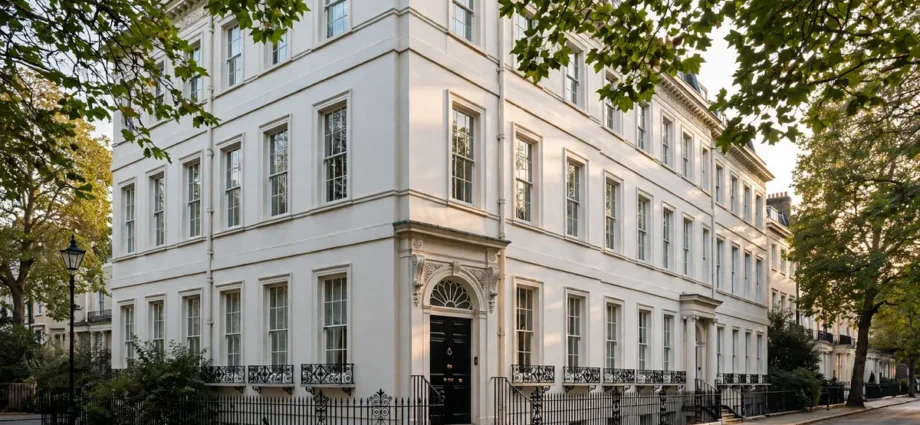
A buyer finds the flat. It is a two-bedroom apartment in a white stucco mansion block in Kensington, or a lateral apartment in a new prime development in Nine Elms, or a penthouse above a concierge building in Mayfair. The price is £2.5 million. The specification is exactly right. Then the particulars say the word that stops many overseas buyers in their tracks: leasehold. The buyer owns the flat, but not the land it stands on, and not the building it sits in. Somebody else does, and that somebody else sets rules, charges fees and holds a reversionary interest that will one day matter.
That is the tenure question, and in prime London it is unavoidable. Leasehold is not a quirk of the cheap end of the market. It is the standard way flats are owned in England and Wales, and in London it is the norm: according to the Ministry of Housing, Communities and Local Government, 39 per cent of homes in London were leasehold in 2024 to 2025, the highest share of any English region, and London holds 1.44 million leasehold dwellings. A luxury buyer does not escape leasehold by spending more. In fact, the more prime the flat, the more likely the freeholder is one of the great historic estates, and the more the lease terms matter.
This guide compares freehold and leasehold for a luxury London flat, explains the third option buyers keep asking about, share of freehold, and sets out what each tenure costs beyond the purchase price, when lease length starts to change the value of the flat, and what leasehold reform has and has not changed as of November 2026. It is general guidance, not legal advice, and the lease itself, read by the buyer’s conveyancer, is always the final word.
In brief: Almost every luxury London flat is leasehold, because a building with many flats and shared areas needs one freeholder. Freehold means owning the property and the land indefinitely, with no lease, no ground rent and no landlord above you; it is the usual tenure for houses, not flats. Leasehold means owning the right to occupy for a fixed term, commonly 99 to 999 years, while a freeholder owns the building and the land. Share of freehold means the leaseholders jointly own the freehold through a company, which gives them control of the building while each flat keeps its own lease. New leases granted on or after 30 June 2022 carry a peppercorn ground rent, effectively zero. The line that matters most is 80 years: below it, extending the lease costs substantially more because of marriage value. A buyer should check the unexpired term, the ground rent, the service charge and the identity of the freeholder before exchanging, and should never assume that a long lease makes tenure irrelevant.
The Three Ways to Own a Luxury London Flat
There are three tenures a buyer of a luxury London flat is likely to meet, and they are not interchangeable.
Freehold means owning the property and the land it stands on outright, indefinitely. There is no time limit on the ownership, no landlord above the owner, no lease to run out and no ground rent. The owner is responsible for the building, its maintenance and its insurance. For a house, that is straightforward. For a flat in a building shared with other owners, it is usually impractical, because somebody has to own the structure, the roof and the communal areas, and that somebody has to be able to enforce contributions from every flat. That is why freehold flats are rare, and why a listing that describes a flat as freehold deserves a careful check by the conveyancer: it may be a share of freehold described loosely, or a converted house sold as a whole, or an unusual title that needs explaining.
Leasehold means owning the right to occupy the property for a fixed period, the term of the lease, while the freeholder owns the land and, in most blocks of flats, the structure and the communal areas. The lease sets the ground rent, the service charge and the rules for using the property. Lease terms vary, but many modern London developments offer extremely long leases, often 999 years. A 999-year lease should be viewed very differently from an older flat with, for example, 70 or 80 years remaining, because the practical difference between 999 years and freehold is small, while the difference between 70 years and freehold is a six-figure extension cost and a mortgage problem.
Share of freehold means the leaseholders in a building jointly own the freehold, usually through a company in which each flat holds a share. Each flat still has its own lease, so the day-to-day structure looks leasehold, but the freeholder is the residents themselves, collectively. That changes who sets the service charge, who chooses the managing agent, who grants consents for alterations and who decides on major works. It does not remove the lease, and it does not remove the service charge, but it removes the external landlord and the profit motive that comes with one.
The comparison, in short, is this. Freehold gives the most control and the most permanence, but it is rarely available for a flat. Leasehold is the standard, and its quality depends entirely on the length of the term, the ground rent, the service charge and the freeholder. Share of freehold is leasehold with the control handed to the residents, and prime buyers often prefer it when it is available, which is why it commands attention in negotiations.
Why Almost Every Luxury London Flat Is Leasehold
Leasehold is the default structure for apartment ownership in England and Wales because a block of flats is a shared building. One owner cannot own the roof, the lift, the entrance hall and the structure outright while another owner owns the flat above, and a building with dozens or hundreds of homes needs a single owner of the common parts who can insure them, maintain them and recover the cost from every flat. The freeholder performs that role, and the lease is the document that sets out what each leaseholder pays and what each side must do.
That logic applies at every price level, and it applies most strongly in prime London, where the buildings are large, the communal areas are extensive and the services are expensive. A luxury development with a concierge, a gym, a residents’ lounge, a pool and a spa has far more shared infrastructure than an ordinary block, and the service charge that pays for it is correspondingly larger. The Hamptons Service Charge Index 2025 puts the average annual service charge in London at £2,801, against £2,405 across England and Wales, and prime buildings with full amenities charge far more than that average. The freeholder, or the management company acting for the freeholder, collects that charge and spends it on the building.
There is a second reason leasehold dominates prime London, and it is historical. Large parts of Prime Central London sit on land owned by the great historic estates, families and institutions that have held the freeholds for centuries. The Cadogan Estate owns much of Chelsea and parts of Knightsbridge. The Howard de Walden Estate is the dominant landowner across Marylebone. The Portman Estate, the Crown Estate, the Grosvenor Estate, the Phillimore Estate and the Mercer Estate hold similarly large areas. When a buyer purchases a flat in one of those neighbourhoods, the freeholder is very likely to be one of those estates, and the lease will reflect estate management practices that have been in place for generations. That is not a reason to avoid the purchase, but it is a reason to read the lease with particular care, because estate freeholders have their own rules on alterations, subletting and use.
What Leasehold Costs Beyond the Purchase Price
The purchase price is only the first cost of a leasehold flat. Three further charges follow, and a buyer should understand all three before exchanging.
Ground rent is the rent the leaseholder pays to the freeholder for the land. For most qualifying new residential leases granted on or after 30 June 2022, ground rent is restricted to a peppercorn under the Leasehold Reform (Ground Rent) Act 2022, which means effectively zero. Older leases carry the ground rent written into the original document, and some of those rise on a review pattern set out in the lease, sometimes doubling at fixed intervals. The guide to ground rent on luxury London flats sets out what prime buyers must check on that charge, including the doubling clauses that have caused so many problems on older leases and the fact that a peppercorn ground rent on a new lease does not make an old lease’s ground rent disappear on resale.
Service charge is the annual cost of running the building: building insurance, communal repairs, cleaning, lighting, lift maintenance, the concierge, the gym and the management fee. It is usually the largest recurring cost of owning a luxury flat, and it is the one most likely to surprise a buyer who has only looked at the purchase price. The charge is set by the freeholder or the managing agent, and the leaseholder’s only protection is the right to challenge a charge that is unreasonable, through the First-tier Tribunal. A buyer should ask for the last three years of service charge accounts, the current year’s budget and any planned major works, because a building about to replace a lift or re-clad a facade will produce a large one-off demand.
The third cost is the cost of the lease itself running down. A lease is a wasting asset: every year that passes, the unexpired term shortens, and the flat loses a little of the value that a longer lease would support. On a 999-year lease that erosion is negligible for a human lifetime. On a 90-year lease it is measurable. On a 70-year lease it is substantial. That is why the unexpired term is a price factor in its own right, and why a buyer should treat a short lease as a cost to be priced, not as a detail to be ignored.
The 80-Year Line: When Lease Length Changes the Value
The single most important number in a leasehold purchase is the unexpired term, and the line that matters most is 80 years.
Above 80 years, extending a lease is a relatively straightforward calculation: the premium reflects the ground rent the freeholder gives up and the value of the reversion, the right to the flat when the lease eventually ends. Below 80 years, a further element enters the calculation, and it is the expensive one. It is called marriage value, and it is the freeholder’s share of the increase in the flat’s value that the extension itself creates. The guide to marriage value explained works through the calculation at prime values, where a marriage value element on a £2 million flat can run into six figures. The guide to lease extension cost on a prime London flat works the full premium at £1 million, £2 million and £3 million values, and shows how steeply the cost rises as the term shortens.
The practical consequences of a short lease go beyond the extension premium. The question every buyer asks is: does a short lease reduce a luxury flat’s value? The discount bands by years remaining show the pattern is consistent: a flat with a short lease sells for less than an identical flat with a long lease, because the buyer is buying both the flat and a future extension bill. Mortgage lenders take the same view. At 50 years or below, lenders will typically refuse to lend at all, which restricts the buyer pool to cash buyers only and depresses the price further. Even at 70 to 80 years, some lenders impose conditions or shorten the mortgage term to match the lease.
The statutory route to an extension is well established. A qualifying leaseholder can extend by 90 years beyond the unexpired term, at a peppercorn ground rent, through the statutory process under the Leasehold Reform, Housing and Urban Development Act 1993. Since 31 January 2025, following Section 27 of the Leasehold and Freehold Reform Act 2024, a leaseholder no longer has to own the flat for two years before claiming an extension; the right arises from the day the buyer is registered as owner at HM Land Registry. That change matters for a buyer who purchases a flat with a short lease intending to extend immediately, because the two-year wait is gone. What has not changed, as of November 2026, is the marriage value element itself: the 2024 Act provides for marriage value to be removed from the calculation, but that provision awaits commencement, and until it is brought into force, marriage value remains payable on extensions below 80 years.
Share of Freehold: The Middle Way Prime Buyers Ask About
Share of freehold is the tenure buyers ask about most often after they understand leasehold, and for good reason. It keeps the leasehold structure that a block of flats needs, but it hands the freehold to the residents.
In practice, the leaseholders in the building jointly own the freehold through a company, and each flat holds a share in that company. The company is the freeholder. It appoints the managing agent, sets the service charge, grants consents for alterations and decides on major works. Because the directors of the company are the leaseholders themselves, the decisions are made by the people who pay the bills and live with the results. Ground rent is usually a peppercorn, because the company has no reason to charge its own members a rent. Extending a lease is straightforward, because the leaseholders are effectively granting the extension to themselves, and the premium for a 999-year extension at a peppercorn rent is typically minimal.
That control has real value at prime level, and it is reflected in prices. A share of freehold flat in the same building as a comparable leasehold flat will usually command a premium, because the buyer is buying control as well as the flat. But share of freehold is not a freehold flat, and a buyer should not confuse the two. Each flat still has its own lease, the lease still sets the rules, and the service charge still has to be paid. The difference is who is on the other side of the lease, and that difference is worth understanding before paying the premium for it.
There are also practical points to check. A share of freehold company needs directors, and somebody has to do the work. In a small building that may mean the residents take turns. In a large prime building the company will usually employ a managing agent, and the quality of that agent matters as much as it does under an external freeholder. A buyer should ask who the directors are, who the managing agent is, whether the company is up to date with its filings, and whether there are any disputes between the leaseholders. A badly run share of freehold company can be worse than a competent external freeholder, and the premium paid for the share is only justified if the company is run well.
Freehold Houses and Leasehold Flats: What Actually Changes
The tenure question is usually asked about flats, but it is worth setting out what changes when the property is a freehold house, because many luxury buyers compare the two.
A freehold house gives the owner complete control. There is no lease, no ground rent, no service charge, no freeholder consent needed for alterations, subject to planning permission and any covenants on the title, and no lease to extend. The owner insures the building, maintains it and pays for everything directly. For a buyer who values autonomy above all, and who is prepared to manage a house, that is the attraction, and it is why freehold houses in prime London command the prices they do.
A leasehold flat gives the owner a home in a managed building, with shared services, shared security and shared maintenance, in exchange for the service charge and the constraints of the lease. The owner cannot alter the flat without the freeholder’s consent where the lease requires it, cannot sublet or use the flat for short lets if the lease forbids it, and must contribute to the building’s costs whether or not they use the amenities. In return, the owner does not have to arrange the building insurance, maintain the roof, run the lift or employ the concierge, because the freeholder does that and recovers the cost.
Neither is better in the abstract. The choice depends on what the buyer wants the property for. A buyer who wants a London base with full services, security and no maintenance burden will usually prefer a leasehold flat in a managed building, and will accept the service charge as the price of that convenience. A buyer who wants a family home, a garden and complete control over the building will usually prefer a freehold house, and will accept the responsibility that comes with it. The mistake is to compare the two on price alone, without comparing the service charge on one side and the maintenance and insurance costs on the other.
The Great Estates: Buying Leasehold on Estate Land
A buyer who purchases a flat in Chelsea, Knightsbridge, Marylebone, Belgravia or Mayfair is very likely buying leasehold on estate land, and the identity of the freeholder matters more there than anywhere else in London.
The great estates are long-term landlords. They have owned the freeholds for centuries, they manage their areas as a whole, and they have their own rules. Those rules typically cover alterations, including anything affecting the external appearance of the building, subletting, short-term letting, and the use of the flat. Consent is usually required, and it is usually granted where the proposal is reasonable, but the process takes time and may carry a fee. A buyer who plans a major refurbishment, or who intends to let the flat, should ask the conveyancer to check the estate’s consent requirements before exchanging, not after.
Estate freeholders also have their own approach to lease extensions. Because they hold many freeholds in the same area, they have established valuation practices, and they are generally professional counterparties. That is a benefit: an extension negotiation with a large estate is usually conducted properly, with surveyors on both sides and a clear process. It is not, however, a reason to assume the premium will be low. Estate freeholders know the value of their reversions, and on a prime flat the extension premium will reflect that.
There is one further point about estate land that overseas buyers sometimes miss. The lease will usually contain a covenant requiring the flat to be used as a private residence, and restrictions on business use. For a buyer who intends to use the flat as a base while working in London, that is rarely a problem. For a buyer who intends to run a business from the flat, it may be. The lease, and the estate’s consent policy, should be checked against the buyer’s actual plans.
Leasehold Reform: What Has Changed and What Has Not
Leasehold reform is the part of this subject where buyers most often hear something that is not quite true, usually because a change that has been passed into law has not yet been brought into force.
What has changed is real. The Leasehold Reform (Ground Rent) Act 2022 restricts ground rent to a peppercorn for most qualifying new residential leases granted on or after 30 June 2022. That means a buyer of a new-build luxury flat will usually pay no meaningful ground rent at all. The Leasehold and Freehold Reform Act 2024 is now law, and one of its provisions is already in force: since 31 January 2025, the two-year ownership requirement for claiming an extension or buying the freehold has been removed, so a new owner can claim from the day they are registered at HM Land Registry.
What has not changed, as of November 2026, is equally important. The 2024 Act provides for marriage value to be removed from the lease extension calculation, and for the standard extension term to change, but those provisions await commencement and have not yet been brought into force. Until they are, marriage value remains payable on extensions where the unexpired term is below 80 years, and a buyer who prices a short-lease flat on the assumption that marriage value has already gone will overpay. The government has said the reforms will be implemented in stages, and the timetable for the remaining provisions has not been confirmed.
The practical advice for a buyer is simple. Do not buy on the basis of reform that has not yet taken effect. Price the flat on the law as it stands today, read the lease as it is written, and treat any future reform as a possible benefit, not as a certainty. If the remaining provisions of the 2024 Act are brought into force, a buyer who already owns a short lease may benefit. But a buyer who pays a price that assumes they already have been brought into force is paying for something that does not yet exist.
Which Tenure Should You Choose?
There is no single right answer, because the right tenure depends on the property, the price and the buyer’s plans. But the decision can be made methodically, and the questions below are the ones that matter.
First, what is the unexpired term, and what does it cost to fix? On a 999-year lease, tenure is a minor consideration. On a 90-year lease, it is a cost to be priced. On a 70-year lease, it is the central issue in the purchase. Ask the conveyancer for the exact unexpired term, and get a surveyor’s view of the extension premium before making an offer, not after.
Second, what is the ground rent, and does it rise? On a new lease granted after 30 June 2022, it should be a peppercorn. On an older lease, read the review pattern. A doubling ground rent on a prime flat is a problem that should be priced or negotiated, not discovered after completion.
Third, what is the service charge, and what does it pay for? Ask for three years of accounts, the current budget and any planned major works. A service charge that looks low may mean the building is under-maintained. A service charge that looks high may mean the building offers services the buyer values. Either way, the figure should be known before exchange.
Fourth, who is the freeholder, and how do they manage? An estate freeholder, a professional freeholder company and a share of freehold company are three different counterparties, and the buyer’s experience of owning the flat will depend on which one they are dealing with. Ask who manages the building, how consents are handled, and whether there are any disputes.
Fifth, what does the buyer intend to do with the flat? Alterations, subletting, short lets, business use and resale are all governed by the lease. A buyer whose plans conflict with the lease will either have to change the plans or walk away, and it is cheaper to discover that before exchange.
If the answers to those questions are satisfactory, a leasehold flat in prime London is a sound purchase, and it is the purchase most prime buyers make. If the answers are not satisfactory, the buyer has three options: negotiate the price to reflect the cost of fixing the tenure, buy a different flat, or buy a freehold house instead. What the buyer should not do is ignore the tenure question because the flat itself is beautiful. The flat is what you live in. The tenure is what you own.
Frequently Asked Questions
Is a luxury London flat usually freehold or leasehold?
Leasehold. Almost every flat in England and Wales is leasehold, and in London 39 per cent of all homes were leasehold in 2024 to 2025, the highest share of any English region. Freehold is the usual tenure for houses, not flats, because a block of flats needs a single freeholder for the structure and the communal areas.
What is the difference between freehold and leasehold?
Freehold means owning the property and the land indefinitely, with no lease, no ground rent and no landlord. Leasehold means owning the right to occupy for a fixed term, commonly 99 to 999 years, while a freeholder owns the land and the building. The lease sets the ground rent, the service charge and the rules for using the property.
What is share of freehold?
Share of freehold means the leaseholders in a building jointly own the freehold through a company. Each flat keeps its own lease, but the residents collectively control the building, set the service charge and grant consents. Ground rent is usually a peppercorn, and extending a lease is straightforward because the leaseholders are effectively granting the extension to themselves.
How long should the lease be on a luxury flat?
The longer the better, and 999 years is the standard on new prime developments. The line to watch is 80 years: below it, extending the lease costs substantially more because of marriage value. At 50 years or below, mortgage lenders will typically refuse to lend, which restricts the buyer pool to cash buyers.
What is marriage value, and when does it apply?
Marriage value is the freeholder’s share of the increase in the flat’s value that a lease extension creates, and it applies where the unexpired term is below 80 years. The guide to marriage value explained works through the calculation at prime values, and the guide to lease extension cost on a prime London flat gives worked premiums at £1 million, £2 million and £3 million.
Do I pay ground rent on a new luxury flat?
For most qualifying new residential leases granted on or after 30 June 2022, ground rent is restricted to a peppercorn under the Leasehold Reform (Ground Rent) Act 2022, which means effectively zero. Older leases carry the ground rent written into the original document, and some rise on a review pattern, so always check the lease.
What does the Leasehold and Freehold Reform Act 2024 change?
The Act is law, but its provisions are being implemented in stages. Since 31 January 2025, the two-year ownership requirement for claiming an extension has been removed. As of November 2026, the provisions removing marriage value from the extension calculation have not yet been brought into force, so marriage value remains payable on extensions below 80 years.
Can I extend the lease on a luxury flat I am buying?
Yes, if you qualify. A qualifying leaseholder can extend by 90 years beyond the unexpired term at a peppercorn ground rent through the statutory process. Since 31 January 2025 there is no two-year waiting period, so a new owner can claim from the day they are registered at HM Land Registry. The premium depends on the unexpired term, the ground rent and the value of the flat, and it rises steeply below 80 years.
Is share of freehold better than leasehold?
It usually gives the buyer more control, because the residents run the building, and it usually commands a premium for that reason. But it is not freehold: each flat still has its own lease, and the service charge still has to be paid. The premium is only justified if the share of freehold company is run well, so check who the directors are and who the managing agent is.
Should tenure affect the price I offer?
Yes. A short lease, a rising ground rent, a high service charge and an uncooperative freeholder all reduce the value of a flat, and a buyer should price them into the offer or negotiate them before exchange. A flat with a 999-year lease, a peppercorn ground rent and a well-run building is worth more than an identical flat without those things, and the market reflects that.
This guide is general information about freehold and leasehold tenure for luxury London flats in the UK as of November 2026. It is not legal, financial, tax or valuation advice. Leasehold reform is being implemented in stages, and provisions of the Leasehold and Freehold Reform Act 2024 that have not yet been brought into force, including the removal of marriage value, do not yet apply. Figures attributed to the Ministry of Housing, Communities and Local Government are from Leasehold dwellings 2024 to 2025, published 21 May 2026, as reported by Imperia Property; the London service charge figure is from the Hamptons Service Charge Index 2025. Check the lease and ask the conveyancer what applies to the purchase before exchanging.