
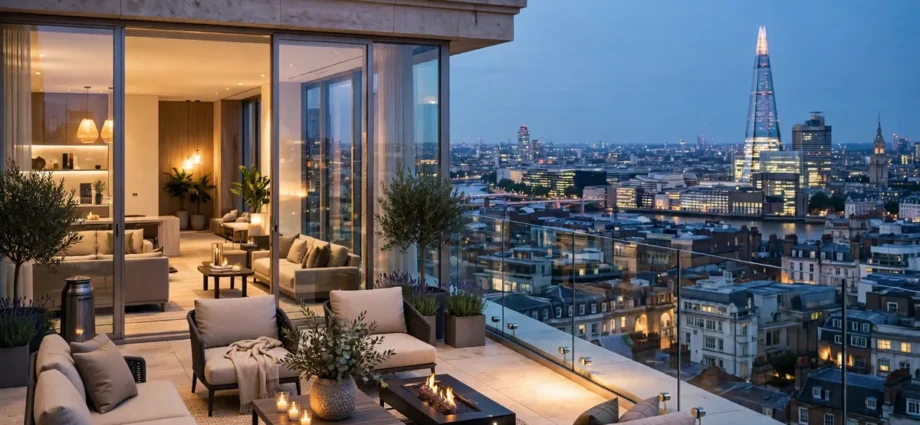
The Luxury Penthouse Premium: Why Penthouses Cost More Per Square Foot
A penthouse is the one flat in a building that can cost half as much again per square foot as the flat directly below it, sometimes far more. The view is the same postcode, the same street and often the same floor plan. What changes is the floor, the ceiling, the terrace and the name on the brochure. For an overseas buyer, the question is not whether penthouses cost more. They do, and the figures are public. The question is whether the premium on the particular penthouse in front of you is real, and how much of it would survive a resale.
Knight Frank research reported in 2021 puts the London penthouse premium at 43 per cent per square foot against the average for the development. That is the headline number, and it is quoted by almost every buying agent in prime London. But a single average hides the spread that matters. A subdivided top floor sold as part of a “penthouse collection” may be worth only 15 to 25 per cent above the middle floors. A true whole-floor penthouse with a protected view and a usable terrace can command 60 per cent or more. The premium is not one number. It is a range, and where a property sits in that range depends on substance, not on the label.
This guide explains what the premium is made of, what the published numbers actually show, how to tell a true penthouse from a rebadged top floor, what the premium costs to run once you own it, and how to test it before you offer. It is general guidance, not legal, tax or financial advice. Prices and rules are stated as they stand in November 2026 and should be checked with your solicitor, surveyor and buying agent before you rely on them.
In brief: a London penthouse typically costs far more per square foot than the flats below it, and Knight Frank research reported in 2021 puts the London premium at 43 per cent. But the label guarantees nothing. A true whole-floor penthouse with a private terrace, direct lift access and protected views can justify a premium of 60 per cent or more, while a subdivided top floor sold as part of a “penthouse collection” may be worth only 15 to 25 per cent above the middle floors. Before you pay the premium, test it. Compare against sales in the same building, separate the view from the terrace from the trophy value, and check the service charge, the lease and who maintains the roof. The premium is real when the substance is real. When it is only a name on a brochure, it is the most expensive word in prime London property.
What the Penthouse Premium Actually Is
The penthouse premium is the difference in price per square foot between the penthouse and comparable flats in the same building. Price per square foot is the right measure, because headline price misleads. Penthouses are almost always larger than the flats below them, so the headline price is higher even before any premium is applied. Comparing price per square foot strips out size and isolates what the top floor itself is worth.
Three points about the measure matter before any number is quoted. First, the comparison must be within the same building. A penthouse in Mayfair and a flat in Clapham differ in location, not in floor, and no premium can be read from that gap. Second, the comparison must be against the same standard of finish. A penthouse with a bespoke interior and a mid-floor flat with a ten-year-old kitchen are not the same product. Third, the premium is a range, not a rate. It moves with the building, the view, the terrace and the market, and a single published average is a starting point for negotiation, not a valuation.
It is also worth saying plainly what the premium is not. It is not a fixed uplift that every penthouse earns. In some buildings the top floor sells for less per square foot than the floors below, usually because the layout is awkward, the terrace is unusable, the view is blocked or the service charge is punishing. A premium that is assumed rather than tested is the most common way an overseas buyer overpays in prime London.
The Numbers: What the Premium Looks Like in London
The most quoted figure comes from Knight Frank research reported in 2021. Across the developments studied, London penthouses commanded a 43 per cent premium per square foot against the development average, and penthouses were on average 129 per cent larger than the other apartments in the same development. The same research put the premium at 59 per cent in Hong Kong and 7 per cent in Singapore, which shows how local the number is. London sits between the two, and the London figure is the one that matters for a UK purchase.
Buying agent Black Brick, in its London penthouse guide updated in November 2026, repeats the Knight Frank 43 per cent figure and adds worked examples from its own purchases. In St John’s Wood, the firm bought a penthouse overlooking Lord’s cricket ground at 3,300 pounds per square foot, while flats lower down the same building could be bought for 1,300 pounds per square foot. At One Hyde Park in Knightsbridge, two apartments that both sold in 2017 achieved 7,369 pounds and 4,152 pounds per square foot. The key difference was that one was on the fourth floor and the other was on the ground and first floors. When the developer Nick Candy listed his One Hyde Park penthouse in 2021, he asked 175 million pounds for the duplex, which works out at 9,722 pounds per square foot. Asking prices are not achieved prices, and the Candy penthouse is an extreme case, but the spread inside a single building shows how wide the premium can run.
A more recent audit, published by Skyscraper News in November 2026, splits the premium by building type and is the most useful published breakdown for a buyer. Subdivided top floors, where a developer has cut the top floor into several flats and sold them as a penthouse collection, run about 15 to 25 per cent above mid-tower units. True whole-floor exclusivity routinely exceeds 60 per cent, and in one Westminster case the penthouse achieved more than double the price per square foot of the floor beneath it. The gap between 15 per cent and more than 100 per cent is the whole story. It is the difference between a label and a property.
One caution applies to every figure in this section. Premiums compress in weak markets, and the trophy element is the softest part. When the prime market falls, the premium on an ordinary top floor falls first, because there is nothing scarce about it. A true penthouse holds its premium better, because there is only one top floor, but it is not immune. The guide to prime central London property prices per square foot explains how the measure is used in prime valuation and why two flats on the same street can price very differently.
What You Are Paying For: The Five Parts of the Premium
The premium is not one thing. It is five things added together, and each one can be valued, questioned and negotiated separately. Breaking it down is the only honest way to test whether an asking price is fair.
The first part is the view, and whether it can be taken away. A direct, unobstructed view over a park, a river or a protected skyline is the scarcest part of any penthouse, because land in prime London is finite and protected sightlines are hard to replicate. A view that looks over a low-rise street today can be a view of a new tower block in five years. Ask what can be built on every neighbouring plot, and check the local planning portal before you offer. A view that cannot be blocked is worth far more than a view that merely has not been blocked yet.
The second part is private outdoor space, and whether it is usable. A terrace that opens directly off the living room, where you can step outside with a coffee or entertain in summer, is worth far more than a rooftop terrace reached by a separate stair, or a terrace off a bedroom that you rarely use. Size matters less than connection. A 2,400 square foot wraparound terrace sounds impressive on a brochure, but if it is exposed to wind, overlooked, or only reachable through a bedroom, it adds little to daily life. The best terraces are sheltered, private and connected to the rooms people actually live in.
The third part is ceiling height, volume and light. A true penthouse has taller ceilings than the floors below, often 3 metres or more, with floor-to-ceiling windows on more than one side. Light from multiple exposures changes how a home feels in a way that square footage alone does not capture. A top-floor flat with standard 2.4 metre ceilings and windows on one side is a flat with a good view, not a penthouse, whatever the brochure calls it.
The fourth part is scarcity and privacy. There is only one top floor in a building, and usually only one penthouse, so supply is capped by the building itself. Direct lift access, a private lift lobby and no neighbours above are part of what the premium buys. In a mansion block or a converted building, check whether the lift actually reaches the penthouse floor. In some period buildings it stops a floor below, and the last flight is by stairs, which changes the value of the top floor considerably.
The fifth part is trophy and brand value. Some penthouses carry a premium because of the address, the architect, or the hotel brand that runs the building. Branded residences add concierge, housekeeping and hotel services, and buyers pay for the name as much as for the space. Trophy value is real, and it can be the largest part of the premium on the most famous addresses. It is also the softest part. In a strong market it grows. In a weak market it compresses first, because it depends on finding the one buyer for whom the address matters.
True Penthouse or Rebadged Top Floor: The Label Problem
In the UK, “penthouse” is a marketing term. There is no legal definition, no planning category and no minimum standard a flat must meet before a developer can use the word. It is applied to true set-back top-floor homes with wraparound terraces, to ordinary highest-floor units that have simply been rebadged, and to everything in between. The premium attaches to the substance, not to the letters.
The most common overpay in the luxury market is a rebadged high-floor unit bought at a penthouse premium. The floor plan and the lease settle what you are buying, not the listing. Before you accept the label, check five things. Is it the whole floor, or one of several flats carved out of the top floor? Does it have direct lift access and a private lobby, or a shared landing? Does it have private outdoor space that is demised to the flat, meaning it is legally part of what you own, or is the terrace communal? Are the ceilings genuinely taller than the floors below? And does the light come from more than one exposure?
Developers have also popularised the “penthouse collection”, a set of top-floor flats in one building all marketed as penthouses. A collection is the opposite of scarcity. If there are six penthouses in a building, none of them is the penthouse, and the premium should be judged as a high-floor premium, not a trophy premium. The Skyscraper News audit puts that distinction at 15 to 25 per cent for subdivided top floors against more than 60 per cent for true whole-floor exclusivity. That is the gap to keep in mind when a brochure uses the word in the plural.
The Premium by Building Type
The premium behaves differently in different buildings, and the building type tells you most of what you need to know before you look at the price.
In new-build prime schemes, the premium is usually widest. Developers price the top of the stack aggressively, and the penthouse is often sold last at the highest price per square foot in the building. The product is also the most complete: full floor, high ceilings, large terrace, direct lift, concierge and amenities. The risk is that the premium is set by the developer, not by the resale market, and off-plan buyers have no comparable sales in the same building to test it against. The guide to buying off-plan luxury property in London covers staged deposits, assignment rules and the valuation risk at completion, all of which apply with extra force to a penthouse, because the premium is the part of the price a valuer is most likely to question.
In period mansion blocks, the premium is narrower and the compromises are more visible. Top floors in mansion blocks were often created from roof space, so ceilings can slope, head height can be limited and the lift may not reach the top floor. The building may be listed, which limits what can be changed. The charm is real, and a mansion block penthouse with a terrace over a garden square can be a wonderful home, but the premium should reflect the compromises, not ignore them.
In branded residences, the premium includes the brand and the services: concierge, housekeeping, spa, pool and restaurant access, run to hotel standard. The services are a genuine benefit for an overseas owner who wants a lock-and-leave home. They are also a recurring cost, billed through the service charge for the life of the building, and they vary by building and operator. Model the service charge across the full hold, not just at entry, because the premium is paid once and the service charge is paid every year.
In warehouse conversions and lateral apartments, the word penthouse is used most loosely. A top-floor flat in a converted warehouse may have generous volume and industrial character, but limited light, a single exposure and no private outdoor space. Judge it as a conversion with a good view, and price it accordingly. The premium for volume alone is smaller than the premium for volume plus terrace plus view plus scarcity.
What the Premium Costs to Run
A penthouse does not only cost more to buy. It costs more to run, and the running costs are part of the premium, not separate from it. Three costs matter most.
Service charges run proportionally heavy. A penthouse is usually the largest flat in the building, so its share of the service charge is the largest too, and in some buildings the share is weighted by floor area or by a points system that gives the top floor extra weight. The charge funds staffing, amenities, reserves and building insurance, and a penthouse in a full-service building can carry a service charge several times that of a mid-floor flat. Ask for the last two years of service charge accounts, ask what is planned, and ask whether any major works are coming. Major works in a prime block, a roof replacement, a lift renewal or a facade repair, can run into tens of thousands of pounds per flat, and the top floor often carries the largest share.
Terrace maintenance is the cost buyers forget. A private terrace needs waterproofing and membrane upkeep, drainage checks, planting and furniture that can withstand wind and weather. A plunge pool or hot tub adds pump and finish maintenance and water costs. The terrace is also the part of the building most exposed to the elements, and repairs to the terrace surface or its drainage can require access through the flat below or scaffolding on the facade, which is disruptive and expensive.
Insurance is higher, for two reasons. The rebuild cost of a penthouse is higher than the market value suggests, because of the specification, the terrace and the roof exposure, and contents cover must reflect art, jewellery and collections that tend to sit in prime homes. Water exposure from the roof and terrace liability are specific risks a standard policy may not cover properly. A reinstatement cost assessment is worth commissioning before you buy, so the sum insured reflects the rebuild cost rather than the purchase price.
Lease, Service Charge and Roof: The Legal Checks at the Top
The legal checks for a penthouse are the same checks that apply to any prime flat, with three additions that only matter at the top of the building.
First, the lease length. A short lease cuts the value of any flat, and on a penthouse the absolute discount is larger because the starting price is higher. Below 80 years, marriage value starts to bite on an extension, and below 60 years many lenders will not lend at all. Ask how many years remain, what the ground rent is and how it changes, and whether the lease has been extended before and at what cost. A penthouse with a short lease is not a bargain. It is a penthouse with a large extension premium still to pay.
Second, the roof. The penthouse inherits the roof, and the lease decides who pays for it. In some leases the top-floor owner carries roof repair responsibility, or a larger share of it, and in others the cost is shared through the service charge. Read the lease, or have your solicitor read it, and find out which arrangement applies. Terrace work can also trigger building-envelope approvals, and in a listed building any visible structure needs consent. The penthouse owner is, in effect, junior partner in the roof, with the best views and the closest exposure to anything that goes wrong with it.
Third, the service charge and the management company. Ask what the service charge covers and what it does not, whether there is a reserve fund, and whether a Section 20 consultation for major works has started. Ask who manages the building and how long they have managed it. A good management company keeps the building in order and the service charge under control. A poor one does the opposite, and changing managers is slow and expensive.
On stamp duty, know your position before you view. Non-resident buyers pay a 2 per cent surcharge on top of the standard stamp duty rates, and the total bill on a multi-million-pound purchase is substantial. The guide to the total cost of buying a luxury property in the UK works through the whole purchase cost at prime price points, including the surcharge, the legal fees and the survey costs, and it is worth reading before you make an offer, because the tax is part of the price, not an afterthought.
How to Test the Premium Before You Offer
A premium that cannot be tested should not be paid. Four checks, done before you offer, will tell you whether the asking price is fair.
Compare within the same building. The only honest comparable for a penthouse is a sale in the same building, ideally on a mid floor with a similar finish. If the building is new and there are no resales, use a close peer building on the same street. Never test the premium against the building’s mid-floor average alone, because the average hides the spread between floors. A penthouse priced against the average of a building with small studios on the lower floors will always look expensive. Priced against a comparable two-bedroom flat on the fifth floor, it may look fair.
Decompose the premium. Split the asking price per square foot into its parts: the view, the terrace, the volume and the trophy value. Price the terrace on its usability, not its size. A terrace off the living room is worth more than a rooftop terrace you rarely visit. Price the view on whether it is protected, not on how pretty it is today. What is left after the view and the terrace is the trophy residue, and that is the part to negotiate hardest, because it is the part that compresses first in a weak market.
Check the view’s protection. Look at the local planning portal for applications on neighbouring plots, and ask the agent what could be built between the penthouse and the view. A protected view over a park or a river is a permanent asset. A view over a low-rise street is a temporary one, and the premium should be priced as temporary.
Use a buying agent. The fee is small compared with the price of a penthouse, and the agent’s job is to find the comparable sales you cannot see, to test the premium against them, and to negotiate the trophy element down. The guide to buying agent fees in prime London explains the retainer and success fee models and what a buying agent does for an overseas buyer. If you are buying from abroad, an agent who can view, measure and check the building on your behalf is worth more on a penthouse than on any other purchase, because the premium is the part of the price that most rewards local knowledge.
When the Premium Is Worth Paying, and When It Is Not
The premium is worth paying when the substance is real. A whole-floor penthouse with a protected view, a usable terrace off the living space, ceiling height that changes how the rooms feel, direct lift access and a long lease in a well-managed building is a different product from the flats below it, and the market will recognise that on resale. If you plan to hold the property for many years, the premium is also easier to justify, because the daily value of the light, the view and the outdoor space accrues to you, not to the next buyer.
The premium is not worth paying when it is only a label. A subdivided top floor marketed as a penthouse, a terrace you will never use, a view that can be built out, a short lease, a service charge with major works coming, or a purchase you plan to resell in two or three years in a soft market are all reasons to walk away or to negotiate hard. The most expensive mistake is to pay a trophy premium for a property that has no trophy qualities, because the resale market will price it as a top-floor flat, and the premium you paid will not come back.
A penthouse is the best flat in a building. That is a fact about the building, not about the brochure. Buy the floor, the terrace, the view and the lease. The name on the listing is free.
Frequently Asked Questions
How much more does a penthouse cost per square foot in London?
Knight Frank research reported in 2021 puts the London premium at 43 per cent per square foot against the development average. In practice the range is wide: subdivided top floors sold as penthouse collections run about 15 to 25 per cent above mid-tower units, while true whole-floor penthouses routinely exceed 60 per cent, and in one Westminster case the penthouse achieved more than double the price per square foot of the floor beneath it. The right figure for any purchase depends on the building, the view, the terrace and the market.
Is a penthouse a good investment?
A penthouse is a home first and an investment second. The same scarcity that supports the price thins the market on exit, because only a handful of qualified buyers exist for any trophy floor, so marketing takes longer than for a standard flat. Trophy assets also tend to correct more slowly than the wider market, because there are fewer transactions to set a new price, but they do correct. Buy a penthouse because you want to live in it for many years, not because you expect a quick gain.
What is the difference between a penthouse and a top-floor flat?
The difference is substance, not height. A true penthouse is usually the whole top floor, with direct lift access, ceiling heights above the standard for the building, light from more than one side, and private outdoor space that is part of what you own. A top-floor flat is simply the highest flat in the building. In the UK, “penthouse” is a marketing term with no legal definition, so the floor plan and the lease, not the listing, settle which one you are buying.
Do penthouses cost more to run than other flats?
Yes. The service charge is usually the largest in the building, because the flat is the largest and the share is weighted by area. Terrace maintenance, waterproofing and drainage are additional costs that a mid-floor flat does not have. Insurance is higher, because the rebuild cost reflects the specification and the roof exposure, and contents cover must reflect what a prime home contains. Ask for two years of service charge accounts before you offer.
Can an overseas buyer buy a penthouse in London?
Yes. There is no restriction on overseas buyers purchasing residential property in England, but non-resident buyers pay a 2 per cent stamp duty surcharge on top of the standard rates, and the total tax bill on a multi-million-pound purchase is substantial. You will also need to pass source of funds checks and arrange a UK solicitor and, if needed, a surveyor and a buying agent. The guide to the total cost of buying a luxury property in the UK sets out the full purchase cost at prime price points.