
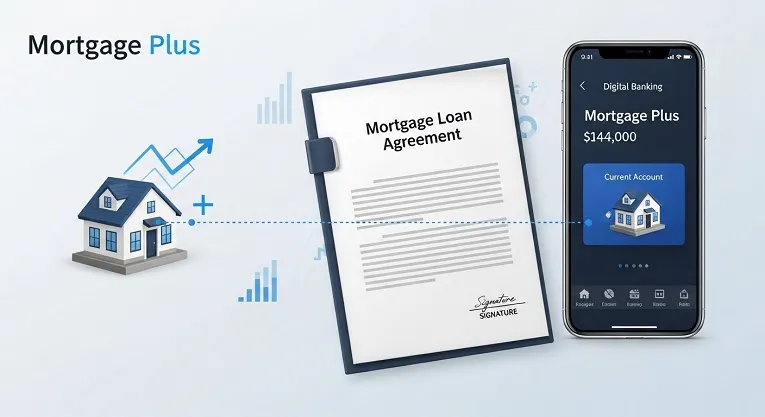
Mortgage and property plus refers to the combined package of enhanced mortgage features and value added property services that many lenders and brokers now offer buyers of high value homes, ranging from flexible overpayment and drawdown facilities to bundled valuation, legal and insurance support arranged through a single point of contact.
Yes. Overseas buyers can get a private bank mortgage for UK luxury property. UK private banks lend to non-residents buying homes worth £2 million and above, with minimum loans typically starting at £1 million. Lenders assess total wealth rather than salary alone, and accept overseas income with a currency haircut of around 20 to 25 percent.
What “Plus” Actually Means in a Mortgage Package
The word plus in this context does not refer to a single named product. Instead, it describes an approach where a lender or broker bundles a standard mortgage with extras that matter more at the higher end of the market, where transactions are larger and more complex than a typical residential purchase.
Common plus features include offset facilities that reduce interest by linking savings to the mortgage balance, flexible drawdown for buyers financing renovation alongside purchase, and access to private banking style underwriting that considers complex income, such as business ownership or overseas earnings, more flexibly than high street lending criteria.
Core Benefits for Buyers of High Value Property
- Bespoke underwriting, which looks at total wealth and complex income structures rather than relying solely on standard payslip based affordability checks
- Offset and flexible repayment options, useful for buyers who want to reduce interest cost without losing access to capital
- Bridging and drawdown facilities, often used when a purchase needs to complete before a related sale or investment realises funds
- Coordinated legal and valuation support, which can shorten timelines on complex purchases such as listed buildings or estates, and matters even more when a corporate structure brings ATED into the picture. See our guide to buying through a limited company for the structuring options.
- Currency and multi jurisdiction advice, relevant for buyers financing property abroad alongside a UK mortgage
How the Application Process Differs from a Standard Mortgage
High value mortgage applications typically move through private banking or specialist lending teams rather than standard retail channels. Expect a more detailed conversation about total assets, income sources and long term financial plans, since lenders at this level are assessing overall relationship value, not just a single transaction.
Valuation can also take longer for unusual or high value properties, particularly listed buildings, large estates or properties with unusual features, since fewer directly comparable sales exist to benchmark against.
Financing a Purchase Alongside an Overseas Property
Buyers who already hold, or are considering, property outside the UK often need financing that accounts for both. If you are researching property in Germany, Austria or Switzerland, our Luxus Immobilien Guide and Luxus Haus Guide explain local buying costs and notary requirements that affect how much financing you will need to arrange. For a wider view of where demand is currently concentrated, our Luxury Property Insights article compares London, Dubai, Monaco and Miami.
Questions Worth Asking a Broker Before You Commit
- Does the lender consider overseas income or business ownership in its affordability assessment?
- Are early repayment charges fixed, or do they reduce over the term?
- Is a drawdown or bridging facility available if completion timing is uncertain?
- What valuation approach will be used for an unusual or high value property?
- Are legal and valuation services genuinely coordinated, or simply referred out separately?
Private Bank Mortgages for Luxury Property in the UK
A private bank mortgage for luxury property in the UK is arranged through a lender’s private banking or wealth arm rather than a high street branch. These facilities suit high net worth borrowers whose finances do not fit standard affordability calculators: entrepreneurs, partners at professional firms, and internationally mobile executives buying homes typically worth £2 million and above.
Minimum loan sizes are the first filter. Most UK private banks start bespoke lending at around £1 million, while specialist private lenders may consider loans from £500,000. Below that level, a mainstream lender’s large loans team is usually more cost effective.
| Lender type | Typical minimum loan | Typical maximum LTV | Relationship requirement |
|---|---|---|---|
| UK private bank | £1m+ | 70–75% | Often £1m–£5m assets under management, or a broker-introduced relationship |
| Specialist private lender | £500,000+ | 70–80% | No investment mandate; focus on asset strength and repayment strategy |
| High street large loans team | £500,000+ | 80–85% | Standard account relationship |
Bespoke underwriting is the core advantage. Instead of a simple salary multiple, the bank assesses total wealth — investment portfolios, business equity, trust assets and projected income — and structures interest-only or part-and-part terms over flexible periods. Pricing is usually quoted as a margin over the Bank of England base rate or SONIA, with arrangement fees of 0.5%–1% of the loan common on larger facilities.
Relationship requirements vary. Traditional private banks generally expect you to hold investments or deposits with them (commonly £1 million or more in assets under management), because the mortgage is priced as part of a wider banking relationship. Challenger private banks and specialist lenders are more transactional: they underwrite the property and the borrower’s balance sheet without demanding an investment mandate, which suits overseas buyers who bank elsewhere.
Bespoke Underwriting for Complex Income
Complex income is where private bank underwriting earns its keep. For business owners, underwriters look beyond salary and dividends to retained profits, director’s loan accounts and the sustainable earnings of the company itself — typically evidenced by two to three years of audited or accountant-certified accounts. For bonus-heavy earners in finance, law or technology, lenders usually average bonuses over two to three years and then apply a discount (often 30–50%) to reflect variability; only the reduced figure counts toward affordability.
What underwriters look for in practice is sustainability and asset backing: a track record of earnings, liquidity to cover 12–24 months of payments from accessible assets, a sensible loan-to-value ratio, and a clear repayment strategy for interest-only borrowing, such as a maturing investment portfolio or a planned liquidity event. Well-documented complexity is an advantage; unexplained complexity is a red flag.
UK Mortgages for Overseas Income Earners
Buyers earning in dollars, euros, dirhams or other currencies can secure UK mortgages, but foreign income is assessed more conservatively than sterling salary. Lenders convert income at current exchange rates and then apply a “currency haircut” — typically 20–25% — to cushion against exchange rate movement over the mortgage term. A US-based buyer earning $400,000 a year might therefore be assessed on roughly £240,000–£250,000 of effective income after conversion and haircut, depending on the lender’s policy. Our guide to non-resident mortgages covers lender options for buyers without UK residency in detail.
| Income currency | Typical haircut | Rationale |
|---|---|---|
| US dollar, euro, Swiss franc | 20% | Deep, liquid currency pairs with long rate histories |
| UAE dirham, Singapore dollar | 20–25% | Pegged or managed currencies; policy varies by lender |
| Other or emerging market currencies | 25%+, or excluded | Volatility and convertibility concerns |
Documentation is heavier than for UK-employed borrowers. Expect to provide six months of payslips or contracts, two years of tax returns, employer or accountant references, bank statements showing salary credits, and certified translations where documents are not in English. Lenders also apply strict source-of-funds checks under UK anti-money-laundering rules, so deposit money should be seasoned in an account in your name with a clear paper trail. Self-employed overseas earners should budget extra time: underwriters often want three years of accounts and may instruct an international credit or background check.
Frequently Asked Questions
What does mortgage and property plus mean?
It describes a mortgage bundled with additional services and flexible features, such as offset facilities, bespoke underwriting and coordinated legal support, aimed at buyers of high value property rather than a single named product.
Is a plus mortgage package more expensive than a standard mortgage?
Rates and fees vary by lender and depend on the specific features included. The value typically comes from flexibility and faster underwriting on complex purchases rather than from a lower headline rate.
Can overseas income be used to qualify for a UK mortgage?
Yes, many private banking style lenders will consider overseas income and complex earnings structures, though documentation requirements are usually more detailed than for standard employed income.
How long does underwriting take for a high value property purchase?
It varies, but complex or unusual properties, including listed buildings and large estates, often take longer to value and underwrite than a standard residential purchase, so buyers should build extra time into their timeline.
Do I need a specialist broker for a high value mortgage?
Not always, but a specialist broker with experience of complex income, overseas assets or unusual property types can often access lending options and terms that are not available through standard high street channels.
What is the minimum loan for a private bank mortgage in the UK?
Most UK private banks start bespoke mortgage lending at around £1 million, although some specialist private lenders consider loans from £500,000. Below that level, a mainstream lender’s large loans team is usually the better route.
How do UK lenders assess foreign income for a mortgage?
Lenders convert overseas earnings into sterling and apply a currency haircut of around 20–25% to allow for exchange rate movement. Only stable, evidenced income counts, and variable or emerging market currency income may be discounted further or excluded.
What documents do overseas income earners need for a UK mortgage?
Typically six months of payslips or contracts, two years of tax returns, employer or accountant references, bank statements, certified translations of non-English documents, and a clear paper trail for the deposit to satisfy anti-money-laundering checks.
Can a company director use retained profits to get a UK mortgage?
Yes. Private banks and specialist lenders often include retained profits, director’s loan balances and sustainable company earnings in affordability, evidenced by two to three years of certified accounts, rather than relying on salary and dividends alone.
How are bonuses treated in UK mortgage affordability checks?
Most lenders average bonuses over two to three years and then discount the figure by roughly 30–50% to reflect variability. A long, documented bonus history with the same employer strengthens the case significantly.
Do I need to move my investments to a private bank to get a mortgage?
Not always. Traditional private banks often expect £1 million or more in assets under management, but challenger private banks and specialist lenders will lend against the strength of your balance sheet and the property without requiring an investment mandate.
Written and reviewed by the My Luxury Property editorial team, who research premium property markets and financing options across the UK and internationally to help buyers make informed decisions. This article is for general information only and does not constitute financial advice; see our disclaimer for details. Have a question about financing a purchase? Get in touch with us here.