
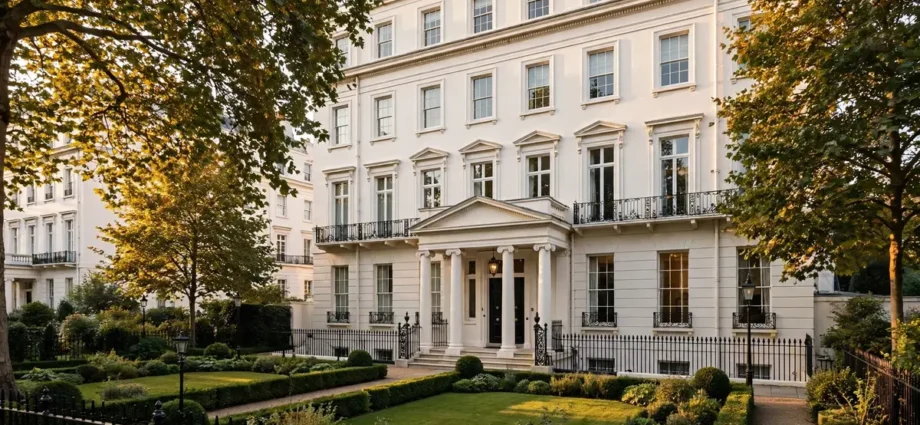
Ask three London agents what super-prime means and you will get three different answers. One will tell you it starts at £5 million. Another will say £10 million. A third will talk about pounds per square foot instead, and quote £4,000. All three are describing the same market, and all three are using a different ruler, which is why the phrase causes so much confusion for buyers arriving in London from overseas.
Super-prime is not a legal category. No statute defines it, no Land Registry class uses it, and no tax rule turns on it. It is a market convention, a piece of shorthand the prime London trade uses for the very top slice of the housing market: the homes that combine an irreplaceable address, exceptional scale or specification, and a price that puts them beyond the ordinary prime market. The confusion comes from the fact that two different conventions are in use at the same time, one drawn at £5 million and one drawn at £10 million, and most of the figures published about the market use one of them without saying which.
This guide settles that confusion. It explains both thresholds and who uses each one, walks the ladder from prime to super-prime to ultra-prime, names the streets and squares where super-prime homes actually sit, describes what a super-prime home has beyond its price, and explains how these homes are bought and sold, which is often very different from an ordinary prime purchase. Every figure carries its source and its date, because in this market the source and the date are the figure.
In brief: Super-prime property is the top slice of the prime London market, roughly the top 1 per cent of homes by value. Two thresholds are in use: Savills counts sales over £5 million as super-prime, while several agencies and developers draw the line at £10 million or at £4,000 per square foot. Prime means roughly the top 5 per cent by value, super-prime the top 1 per cent, and ultra-prime means homes over £100 million, of which fewer than 20 locations worldwide exist, London being one of them. The homes sit in Mayfair, Belgravia, Knightsbridge, Kensington and Chelsea at their best, are often over 500 square metres, and frequently sell off-market. There is no single official super-prime price, and any guide that states one without naming its convention is hiding the basis.
The Short Answer: What Super-Prime Means
A super-prime home is a home at the very top of the prime market, where price stops being the main story and scarcity takes over. The working definition used by most of the London trade has four parts, and a home needs most of them to earn the label.
First, the address must be irreplaceable. Super-prime homes sit on streets and squares where almost nothing comes to market in a normal year: the garden squares of Belgravia, the mansion streets of Mayfair, the best addresses in Knightsbridge and Kensington. A buyer cannot simply choose a different street and get the same thing, because there is no equivalent street.
Second, the scale must be exceptional. A planning consultation document from the Royal Borough of Kensington and Chelsea describes super-prime homes as luxury high-specification units typically over 500 square metres, built for international investors. Five hundred square metres is roughly 5,380 square feet, which is a very large London home by any measure, and many super-prime houses are larger still.
Third, the specification must be bespoke rather than standard. Super-prime homes are finished to a standard that cannot be bought off the shelf: stone, specialist joinery, private amenities, and design that is specific to that house rather than repeated across a development.
Fourth, the price must sit beyond the ordinary prime market. This is where the two conventions disagree, and it is the part of the definition that needs the most care, because the threshold you choose changes every number that follows.
None of this is defined in law. The label is useful because it tells a buyer, in one word, that the normal rules of the prime market, comparable sales, published asking prices, standard mortgage valuations, do not apply in the usual way. It is misleading only when it is used as if it were a precise category with a single price attached to it.
The £5 Million vs £10 Million Problem
The single most important thing to understand about super-prime is that two thresholds are in use, and every market figure you read uses one of them.
The £5 million convention comes from Savills, whose researchers count sales over £5 million as super-prime. PropertyWeek reported Savills figures for the first half of 2021: 237 super-prime transactions in London totalling £2.28 billion, with Chelsea accounting for 14 per cent of deals and Kensington 13 per cent, and activity concentrated in the £5 million to £10 million band, which saw 179 of those 237 deals. That is useful data, and it is also five years old, so it describes the shape of the market rather than its current size. Under this convention, a £6 million flat in Chelsea is super-prime, and the market looks large and active.
The £10 million convention is used by several agencies and developers. Galliard Homes describes a “Super-Prime league” of £10 million and above, alongside a “Prime league” of £5 million and above. The buying agency Best Gapp and the agency Longrad both put super-prime at over £10 million. Under this convention, a £6 million flat is prime, not super-prime, and the super-prime market looks much smaller, rarer and more concentrated.
A third yardstick is also in use: price per square foot. PropertyWire, writing in 2020, pegged super-prime at over £4,000 per square foot in Mayfair, Belgravia, Kensington and Chelsea. Longrad uses the same figure alongside the £10 million threshold, and the guide Living on the Côte d’Azur cites a London threshold of around £10 million or £4,000 per square foot. The per-square-foot yardstick catches something the headline price misses: a small flat on the best street in Mayfair can be super-prime at £7 million because its per-square-foot figure is extraordinary, while a large house in a lesser location can cost £12 million and still not be super-prime.
So which threshold is right? Both, and neither. They are conventions for counting, not facts about houses. The honest answer is that super-prime starts at £5 million in Savills data and at £10 million in most agency usage, and that any figure about the super-prime market is meaningless until you know which line the source drew. This guide uses £10 million as its working definition, because that is where the market changes character: above £10 million, homes trade rarely, often off-market, and to a small pool of buyers. Where a figure in this guide comes from a source that uses the £5 million line, the guide says so.
The Ladder: Prime, Super-Prime and Ultra-Prime
The three tiers sit on top of each other, and each one is defined by its relationship to the one below it. The table sets out the ladder as the trade generally uses it, with the important warning that the bands overlap and the boundaries are conventions.
| Tier | Value band | Share of the market | Where it sits |
|---|---|---|---|
| Prime | Top 5 per cent by value, roughly £2 million to £10 million | The top 5 per cent of homes by value | Prime central London and the best outer prime areas |
| Super-prime | Top 1 per cent by value, over £10 million or over £4,000 per square foot | The top 1 per cent of homes by value | Mayfair, Belgravia, Knightsbridge, Kensington and Chelsea at their best |
| Ultra-prime | Over £100 million | A handful of homes | Fewer than 20 locations worldwide, London one of them |
Prime is the broadest tier. The convention, used by Savills and Knight Frank, is that prime means the top 5 per cent of homes by value. Longrad puts the prime band at roughly £2 million to £10 million. A prime home is an expensive home in a good location: a well-located flat in Kensington, a family house in Chelsea, a lateral apartment in Marylebone. Most overseas buyers looking for a prime London home are shopping in this tier.
Super-prime is the top 1 per cent. Under the £10 million convention it starts where prime ends, and under the Savills convention it overlaps with the top half of prime. Either way, it is a small market. The homes are the finest on the finest streets, and they trade in small numbers. The PropertyWeek figures for the first half of 2021, 237 transactions over £5 million in six months, show how thin even the broader definition is: a few hundred sales a year across the whole of London, against tens of thousands of transactions in the wider market.
Ultra-prime is a different world again. Best Gapp puts ultra-prime at over £100 million, and notes that there are fewer than 20 locations in the world where such homes exist, with London one of them. These are the houses that make international headlines when they sell, and they are so rare that counting them as a market at all is questionable. They are better understood as individual assets than as a segment.
The ladder matters because the tiers behave differently. Prime homes are marketed openly, valued against comparable sales, and bought by a broad pool of buyers. Super-prime homes are often marketed quietly or not at all, valued with few comparables, and bought by a small pool of buyers who usually already own in London. Ultra-prime homes are sold privately, one at a time, and the price is whatever two parties agree. A buyer who applies prime-market habits to a super-prime purchase, expecting published asking prices and a choice of comparable sales, will misunderstand the negotiation from the start.
Where Super-Prime Lives
Super-prime is a matter of streets, not postcodes. The same postcode can contain a super-prime square and an ordinary prime street two turnings away, and the price difference between them can be several thousand pounds per square foot. The guide to the most expensive streets in London showed the same pattern from the sold-price side: a small number of streets account for a large share of the value at the top of the market.
The core super-prime areas are consistent across every source: Mayfair, Belgravia, Knightsbridge, Kensington and Chelsea. Galliard Homes adds Marylebone to the prime and super-prime map, and Best Gapp names Knightsbridge and Belgravia as the strongest areas in 2025, with several sales over £40 million in Mayfair and Holland Park. The 2021 Savills figures, reported by PropertyWeek, put Chelsea first with 14 per cent of super-prime deals and Kensington second with 13 per cent, which shows that the centre of gravity has been stable even as individual streets rise and fall.
Within those areas, super-prime means the best streets and squares: the garden squares of Belgravia, the mansion streets around Hyde Park, the stucco terraces of Kensington, the quiet streets of Mayfair that never appear in a property search because nothing is ever listed there. Much of the stock in these areas sits on the great London estates. PropertyWire noted in 2020 that the Grosvenor Estate and the Howard de Walden Estate own much of the central London stock in these areas, which is one reason so little of it ever comes to market: estate-owned homes change hands slowly, and many are held on long leases rather than sold freehold.
Scale is part of the geography. The Royal Borough of Kensington and Chelsea planning document describes super-prime units as typically over 500 square metres, and cites a 2008 sale on Kensington Palace Gardens at £8,500 per square foot as an example of the level these homes reach. Kensington Palace Gardens is the extreme case rather than the norm, but it illustrates the point: at the top of the market, the address itself is a large part of the price, and the price per square foot can reach levels that look impossible when compared with the rest of London. The guide to Prime Central London property prices per square foot explained sets out the per-square-foot bands for each tier in full, and the super-prime band there is the same £3,500 to £6,000 or more per square foot that the vendor guides quote.
What a Super-Prime Home Has Beyond the Price
Price alone does not make a home super-prime. A large house in a lesser location can cost £12 million and still not be super-prime, while a smaller home on the best street can be super-prime at £8 million. What separates them is what the home contains and what it offers that cannot be bought elsewhere.
The first difference is space, and not just floor area. Super-prime homes have ceiling heights, room proportions and layouts that are difficult to reproduce in a new building: double-height reception rooms, lateral floor plates that run across a whole building, private gardens and terraces that are genuinely private rather than shared. The Royal Borough of Kensington and Chelsea figure of 500 square metres is a floor area, but what the buyer is really paying for is the quality of that space, not just the quantity of it.
The second difference is the private amenities. Longrad lists private cinemas, wine cellars, wellness suites and concierge services as standard super-prime features, and PropertyWire adds valet parking, terraces and unique design to the same list. A super-prime home is often a self-contained world: a pool and spa in the basement, a cinema room, a gym, staff accommodation, secure parking, and a concierge who handles everything from restaurant bookings to household management. These are not decorations. They are the reason the home commands its price, because they cannot be added to an ordinary flat after the purchase.
The third difference is that the home is finished, not a project. Super-prime buyers expect to move in and live, and the furnishing is part of the purchase rather than an afterthought. Turnkey furnishing, where a designer furnishes the whole home before the buyer arrives, is common at this level, particularly for overseas owners who may visit only a few times a year. The costs and the process are set out in the guide to furnishing a London property turnkey, and they are substantial, because the furniture, art and fittings in a super-prime home are themselves a significant asset.
The fourth difference is scarcity. Living on the Côte d’Azur, in its definition of super-prime real estate, stresses irreplaceable location, bespoke architecture and scarcity as the three defining qualities, and scarcity is the one that matters most. A super-prime home cannot be replaced by building another one, because the street is already built, the square is already laid out, and planning rules protect both. That is why these homes hold their value differently from ordinary prime homes, and why their owners are often willing to wait years for the right buyer rather than accept a lower price.
How Super-Prime Homes Are Bought and Sold
The super-prime market works differently from the prime market, and a buyer who expects the ordinary process will be surprised at every stage.
The first difference is that many super-prime homes are never advertised. They change hands through private networks: an agent calls a small list of known buyers, a buying agent approaches an owner on behalf of a client, or a solicitor quietly tests whether an owner would sell. The guide to off-market luxury property explains this world in detail, and the short version is that the best homes are usually sold before they ever reach a property portal, if they reach one at all. A buyer who only looks at advertised homes is looking at the part of the super-prime market that did not sell privately.
The second difference is discretion. Viewings are by appointment, often at short notice, and often conditional on proof of funds before the viewing is confirmed. The owner may not want neighbours, staff or the press to know the home is for sale, and the buyer may not want anyone to know they are buying. Photographs may not exist, floor plans may be withheld, and the address may not be disclosed until late in the process. This is not secrecy for its own sake. At this level, a public listing can damage the price by signalling that the owner needs to sell.
The third difference is the negotiation. There are few comparable sales, because so few super-prime homes trade in any given year, and the ones that do trade are often sold privately with their prices undisclosed. A valuation is therefore a matter of judgement rather than arithmetic, and the negotiation is about what the home is worth to this particular buyer rather than what the market says it is worth. That is why buying agents matter more at this level than anywhere else in the London market: their value is not in finding the home, which the buyer may already know about, but in knowing what it is actually worth and how the owner thinks.
The fourth difference is the money. The purchase costs on a super-prime home are large in absolute terms even when the percentages are familiar, and the tax position is more complex than for an ordinary purchase. Stamp duty on a second or additional property carries a surcharge that rose from 3 per cent to 5 per cent in October 2024, according to Best Gapp, and the non-dom regime that many overseas buyers relied on was abolished in April 2025. The full cost stack, worked at £1 million, £3 million and £5 million, is set out in the guide to the total cost of buying a luxury property in the UK, and the figures scale up sharply at super-prime prices: on a £15 million purchase, stamp duty alone runs into seven figures, and the buyer needs to have planned for it before the offer is made, not after.
Due diligence is also heavier. Source of funds checks are more searching at this level, and the buyer’s solicitor will want a clear paper trail for the money. That is normal and should not be treated as a difficulty. It is part of buying at the top of the market, and a buyer who has their funds documented in advance will move faster than one who has to assemble the evidence during the transaction.
What Super-Prime Costs to Own
The purchase price is the beginning of the cost, not the end of it. A super-prime home costs more to own than a prime home of the same size, for reasons that are easy to underestimate.
Service charges on super-prime flats, where the building provides concierge, security, lift maintenance, common parts and sometimes a pool or gym, can run to tens of thousands of pounds a year, and on the largest mansion blocks they can be higher still. Insurance is priced on rebuild cost rather than market value, and the rebuild cost of a listed stucco mansion with specialist materials is far higher than the rebuild cost of an ordinary house. Council tax on a Band H home in central London is the highest band, and second-home premiums can add to it. Staff, security, garden maintenance and the running of private amenities all add to the annual total.
None of these costs is a reason not to buy. They are a reason to budget for ownership as carefully as for the purchase, and to ask the agent for the service charge history, the insurance premium and the council tax band before the offer is made rather than after it is accepted. A buyer who has only budgeted for the price will find the first year of ownership an unpleasant surprise.
Super-Prime vs Prime: What Changes for the Buyer
The practical differences between prime and super-prime come down to five things, and a buyer who understands them will make better decisions in both markets.
Comparables are scarce. In the prime market there are usually enough recent sales on the same street to support a valuation. In the super-prime market there may be one or two, or none, and the valuation depends on the agent’s judgement rather than on data.
Marketing is quiet. Prime homes are advertised openly. Super-prime homes are often sold privately, and the buyer who waits for a listing may never see the best homes at all.
Negotiation is personal. Prime purchases are negotiated against the market. Super-prime purchases are negotiated against the owner, and the owner’s reasons for selling, timing, privacy, and the identity of the buyer, can matter as much as the price.
Due diligence is heavier. Source of funds checks, tax advice and structuring all take longer at super-prime level, and the buyer should start them before the offer rather than after it.
Running costs are higher. Service charges, insurance, staff and maintenance all scale with the size and specification of the home, and the annual cost of owning a super-prime home is a serious figure in its own right.
None of this makes super-prime a better or worse market than prime. It makes it a different market, with different rules, and the buyers who do well in it are the ones who learn those rules before they start looking.
Frequently Asked Questions
What is the super-prime threshold in London?
There are two conventions in use. Savills counts sales over £5 million as super-prime, while several agencies and developers draw the line at £10 million, or at £4,000 per square foot. This guide uses £10 million as its working definition and says so wherever a figure comes from a source that uses the £5 million line.
Is super-prime the same as prime central London?
No. Prime central London is a place, the central London districts where the most expensive homes sit. Super-prime is a price tier within that place, the top 1 per cent of homes by value. A home can be in prime central London without being super-prime, and the distinction is about price and scarcity, not geography alone.
What is ultra-prime property?
Ultra-prime means homes over £100 million. Best Gapp notes that there are fewer than 20 locations in the world where such homes exist, and London is one of them. These are individual trophy assets rather than a market segment.
How many super-prime homes sell each year?
Few, and the number depends on which threshold is used. Savills figures reported by PropertyWeek counted 237 transactions over £5 million in London in the first half of 2021, totalling £2.28 billion. That is dated data, and it uses the £5 million line, so it describes the broader definition rather than the £10 million market.
Do super-prime homes sell off-market?
Often. Many of the best super-prime homes change hands through private networks and are never advertised. A buyer who only looks at property portals is looking at the part of the market that did not sell privately.
What stamp duty applies to a super-prime purchase?
The standard stamp duty bands apply, plus a surcharge on second and additional properties that rose from 3 per cent to 5 per cent in October 2024. The non-dom regime was abolished in April 2025. The full cost stack is worked through in the guide to the total cost of buying a luxury property in the UK.
Is a super-prime home a good investment?
That is the wrong question, and this guide does not answer it. Super-prime homes are bought for use, for scarcity, and for the address, and their value depends on factors that cannot be reduced to a yield. Galliard Homes noted in a guide edited in August 2025 that super-prime was outgrowing prime central London at 7.1 per cent a year, but a growth rate for a segment is not a promise about any individual home, and no buyer should treat it as one.